Avocado Tree Water Usage vs Lawn Irrigation: Calculating California Farm Water Needs
Some links below earn us a small commission at no extra cost to you. We only link to what we actually use. How this works
A mature avocado tree and a modest patch of lawn use roughly the same amount of water over a growing season — that is what we found when we ran the numbers on our own farm. Calculations surrounding water usage are among the most critical decisions for any property owner in California, especially for those managing production fruit orchards or backyard homesteads. Understanding how much water your trees require compared to traditional turf grass can help you optimize irrigation, reduce unnecessary waste, and maintain healthy crop yields.
When making decisions about landscape modifications on our second-generation family avocado farm in Escondido, California, we closely analyze the water footprint of every addition. In this article, we examine how lawn grass water consumption compares directly to mature avocado tree irrigation and how you can manage your own property’s water needs effectively.
Comparing Avocado Tree and Lawn Grass Water Needs
Avocado trees are known for requiring consistent moisture to produce high-quality fruit, maintain vigorous leaf canopy, and avoid stress-induced fruit drop. However, turf grass is frequently criticized as an excessive consumer of irrigation resources. To determine the actual impact of adding a small lawn area for our children, we conducted a direct water usage calculation comparing standard residential turf to mature avocado trees.
Our findings showed that a modest lawn footprint consumes approximately the same volume of water as a single mature avocado tree over the course of a standard growing season. Because our new lawn was placed in an area previously occupied by a single mature avocado tree that had been removed years earlier, and because we are planning to remove a few trees this fall, our total property water consumption remained essentially net-neutral.
Read nextAvocado Heat Stress: Managing Irrigation and Wilting Leaves During Extreme Temperatures
Key Factors Influencing Avocado Irrigation Requirements
Irrigating avocado trees effectively involves understanding several key biological and environmental variables:
- Root depth and structure: avocado feeder roots are shallow and inefficient at taking water up, so they need steady moisture near the surface rather than deep reserves. Why that makes avocados a thirsty crop goes into the biology.
- Evapotranspiration rates: Temperature, ambient humidity, and wind speed in regions like San Diego County significantly increase atmospheric water demand during peak summer months.
- Soil drainage and aeration: standing water hurts avocados twice, by suffocating roots and by favoring Phytophthora root rot, so drainage matters as much as volume. More water is emphatically not better.
- Tree age and canopy size: A young tree requires far less total volume than a full-grown mature tree bearing hundreds of pounds of fruit, but it needs that water more often (see below).
Watering Mistakes That Undo the Calculation
Getting the volume right on paper does not help if the water goes on wrongly. The three failures that actually kill California trees — over-watering heavy clay, missing irrigations through fruit set, and watering against the trunk instead of out at the drip line — are set out with the reasoning from Avocado Production in California: A Cultural Handbook for Growers, Book Two in our guide to how much water an avocado tree needs.
How to Calculate Your Property Water Footprint
To balance outdoor living spaces with productive agricultural land, property owners should establish clear irrigation benchmarks. Follow these basic steps to monitor and control your water usage:
- Determine the square footage of your lawn or crop canopy.
- Measure application rates by tracking gallon output per minute from drip emitters or sprinkler heads. Replacement emitters and heads come from Drip Depot.
- Adjust irrigation frequency based on seasonal weather patterns, increasing runtime during summer heat waves and reducing output during cooler winter periods. Do not switch off for the winter, though: avocados use water all year, and in dry winters growers keep irrigating.
- Mulch thoroughly around fruit trees to retain soil moisture and lower overall evapotranspiration rates. Several inches of straw or wood chips works well; keep it pulled back from the trunk, avoid manure (too salty), and on young trees in frost-prone spots skip winter mulch so the sun can warm the soil. Free chips in bulk: ChipDrop. Because mulch cuts evaporation, a mulched tree is also easy to over-water, so check the soil rather than running the same schedule.
The Per-Tree Figure Behind the Comparison
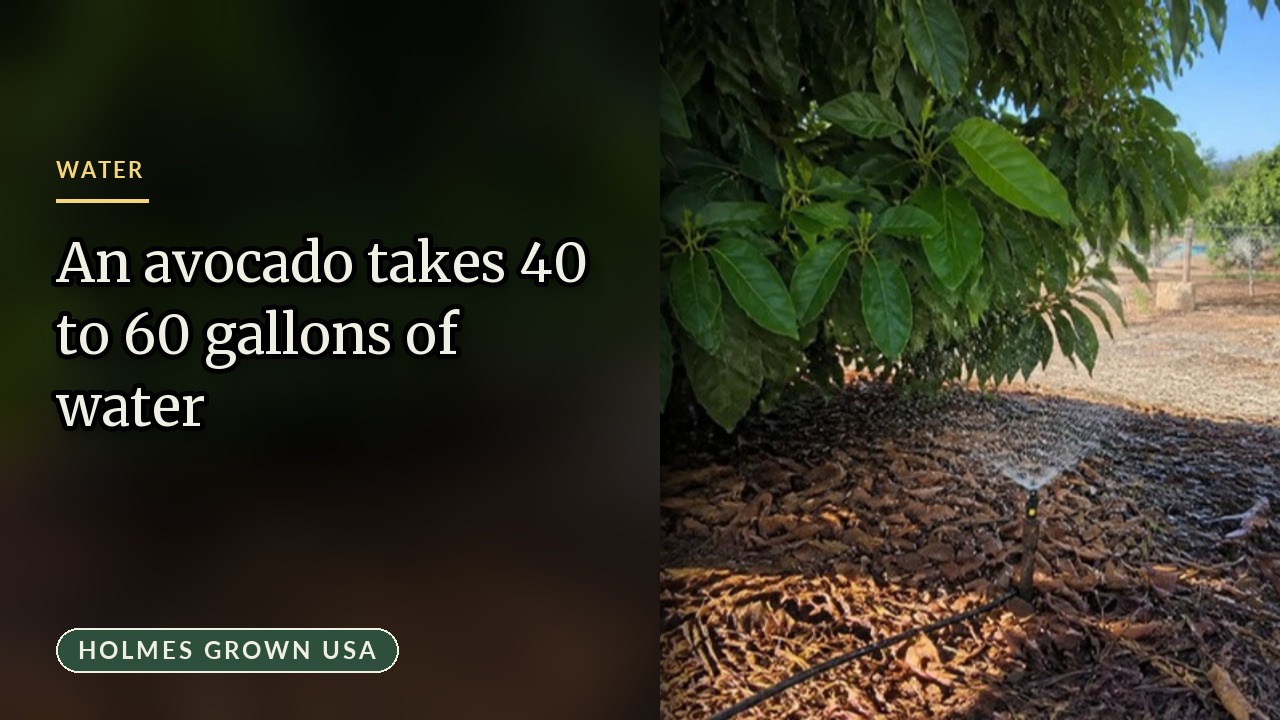
The number driving the comparison above is roughly 40 gallons per tree per day at the summer peak, from the UC handbook’s planning figure of at least 4,500 gallons a day for a mature acre at 20-by-20-foot spacing. Set against a lawn, that is the figure to use. In this climate nearly all of it comes from the irrigation system rather than the sky.
The month-by-month version — about 57 gallons a day in July down to 20 in January, and what that totals over a year — is in how much water an avocado tree needs, along with young-tree volumes, which are a different job entirely. If you want the figure expressed per piece of fruit rather than per tree, that is how much water it really takes to grow one avocado.
Quality Counts as Well as Quantity
Volume is not the only thing that matters: avocados are unusually sensitive to salt, and chloride is the worst offender, so water that is plentiful but salty can still cost you yield. The electrical-conductivity thresholds, the Escondido trial that measured a 40 percent loss on reclaimed water, and how much extra to apply for leaching are all covered from the supply side in our well drilling write-up.
Balancing Family Life and Sustainable Agriculture
Creating a functional homestead often requires balancing agricultural production with practical family living spaces. Providing green areas for outdoor activity does not necessarily mean compromising water conservation goals, provided the overall ecosystem usage is carefully planned and calculated. By replacing a single missing tree footprint with an equivalent turf zone, family farms can maintain precise water management without increasing total utility demand.
Whether the water is justified at all is a fair question, and a different one from this page’s arithmetic. We take it up in why avocados need so much water, and what you get for those gallons.
Optimize Your Orchard Irrigation Today
If you are unsure how much water your specific avocado trees need or want to eliminate guesswork from your watering routine, utilize our free online tools. Run your numbers through our irrigation calculator to work out what your own trees need and take the guesswork out of your watering routine.
This is part of our complete guide to how much water an avocado tree needs — covering usage per fruit, seasonal scheduling, and the watering mistakes that kill California trees.