Avocado Water Footprint and Nutrition: The Truth About Avocado Sustainability
Avocados do need a lot of irrigation in dry Southern California, but measured by the healthy fat they deliver per gallon, they compare well with foods people rarely question, like almonds. Avocado water footprint discussions often focus purely on gallon counts without considering the dense nutritional value packed inside each fruit. While growing avocados in semi-arid regions like Southern California requires careful water stewardship, assessing sustainability purely on water volume tells only half the story. When evaluated by the volume of beneficial monounsaturated fats produced per gallon of irrigation water, avocados use far less water than almonds and come out slightly ahead of walnuts and olive oil.
Why Avocados Need So Much Water
The answer is in the roots. Because 80 to 90 percent of an avocado’s feeder roots sit in the top 8 to 10 inches of soil, and those roots have very few root hairs, the tree is both shallow and inefficient at taking water up. It cannot reach deep groundwater the way a deeper-rooted tree can, and it cannot extract much from soil that is drying out. So it needs moisture kept steadily available near the surface rather than delivered in occasional soakings.
Then there is where it is grown. Rainfall in Southern California’s avocado country averages only about 11 to 15 inches a year and can drop as low as 3.5 inches, so nearly all of a grove’s water arrives through irrigation. A shallow-rooted, inefficient drinker in a semi-arid climate is, unavoidably, a thirsty crop.
Grove management moves the figure, though. In modern high-density plantings, canopy shading and optimized micro-sprinklers cut surface evaporation noticeably, so the water used per fruit falls as spacing and canopy management improve. If you want the gallons-per-fruit arithmetic itself, we work it through in how much water it really takes to grow one avocado.
Read nextAvocado Nutrition Facts: What Is Really in One, and What the Research Shows
We Are Not Going to Pretend Otherwise
There is no honest way around the scale of it. A mature acre of avocados needs at least 4,500 gallons a day through a Southern California summer, even on drip, and the trees drink all year rather than only in the heat. The month-by-month figures in Avocado Production in California: A Cultural Handbook for Growers, Book Two, and what they come to per acre over a year, are in how much water it takes to grow one avocado. For the same water set against a backyard lawn, see avocado tree water usage versus lawn irrigation.
This page is about what you get back for those gallons.
Measuring Sustainability by Nutritional Yield
Looking only at the gallons of water required per piece of fruit is a flawed method for measuring agricultural sustainability. A head of iceberg lettuce requires relatively little water compared to tree fruit, but it also delivers minimal calories, healthy fats, or micronutrients. A true assessment of sustainable agriculture evaluates the nutritional output generated from every gallon of water invested.
Avocados stand out in the produce section because of their high concentration of heart-healthy monounsaturated fatty acids. When our team examined the water footprint per gram of beneficial fat, the comparative figures were eye-opening:
- Avocados: 3.5 gallons of water per gram of monounsaturated fat
- Walnuts: 3.8 gallons of water per gram of monounsaturated fat
- Olive Oil: 3.8 gallons of water per gram of monounsaturated fat
- Almonds: 8.5 gallons of water per gram of monounsaturated fat
Almonds are widely embraced as a healthy fat source, yet they require more than double the water per gram of good fat compared to an avocado. Consumers looking to minimize their agricultural water footprint while maintaining adequate healthy fats in their diet can make a substantial impact simply by choosing California-grown avocados.
Irrigation Efficiency on the Family Farm
Because agricultural water in California is among the most expensive in the nation, local growers cannot afford to waste a single drop. Maximizing efficiency requires continuous monitoring of weather trends, soil moisture levels, and seasonal crop demands.
Proper irrigation management involves adjusting run times to match weekly evapotranspiration rates and inspecting micro-sprinklers to ensure uniform distribution under the canopy. The handbook’s check is simple: catch the output of at least a dozen emitters once a year, compare the lowest quarter with the average, and if that distribution uniformity falls below 80 percent, something must be done, most often basic maintenance such as flushing lines and cleaning filters. By targeting water delivery directly to the shallow root zone and applying organic mulch to prevent surface evaporation, family farms are able to produce high-value, nutrient-rich food while conserving vital regional resources.
Why More Water Is Not Better
Sustainability also means not over-watering, and avocados punish it. The handbook notes that roots begin to die from lack of oxygen after 48 hours of flooding even with no disease present, and that Phytophthora root rot, still the most important disease of California avocados, is much worse in poorly drained soils. The same shallow, hair-poor root system that makes the tree thirsty also makes it quick to drown.
Water quality pulls the same way: salt that is not flushed below the root zone costs yield, so growers deliberately apply a little more than the trees use. How much more, and what counts as water too salty to use, is in our well drilling write-up. Efficient irrigation is the right amount, at the right time, of water the tree can actually use.
How California Growers Have Cut Water Use
Hillside avocado farming in Southern California was made possible by efficiency. According to the handbook, groves have been planted on steep slopes since the 1970s, thanks largely to low-volume irrigation systems and fertilizer injected directly through the irrigation water. Mulching helps too: the handbook recommends a wood mulch three to four inches deep, kept away from the trunk, in replanted groves.
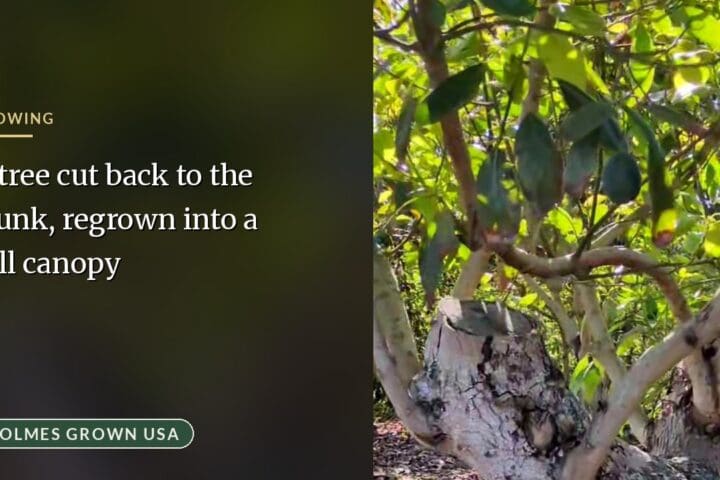
Price has enforced discipline. During the 2007 drought, growers on the interruptible agricultural water plan had to cut water to their groves by 30%, and many used the time to stump back trees that had grown too tall. By 2012, water cost $1,100 per acre-foot in Fallbrook and $1,300 to $1,400 in the Valley Center Water District. At those prices, wasted water is money growers do not have.
Evaluating Your Own Grove Water Needs
Whether you manage a backyard tree or oversee commercial acreage, calculating exact water volume based on weather data and canopy diameter is essential for preventing root stress and conserving water. If you want to dial in your watering schedule and eliminate guesswork, run your grove numbers through our specialized irrigation tool.
Our free Avocado Irrigation Calculator works out how many gallons your tree needs this week and how long to run the water.
This is part of our complete guide to how much water an avocado tree needs — covering usage per fruit, seasonal scheduling, and the watering mistakes that kill California trees.