Fuerte Avocado Season: Transitioning from Hass Harvest to California’s Heritage Variety
Fuerte season is the most satisfying transition of our year. The summer Hass trees come clean, the weather turns, and the green-skinned variety that put California avocados on the map a century ago starts sizing up for winter.
The end of the Hass harvest
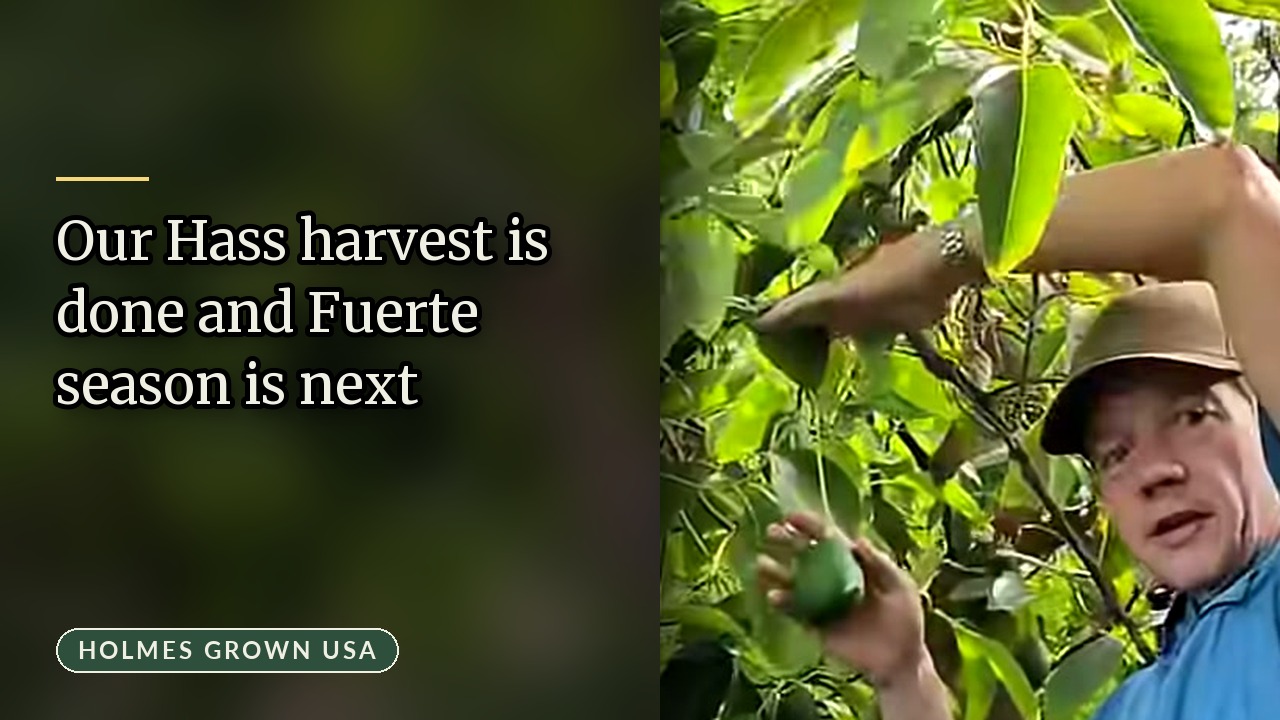
Hass holds the grocery spotlight most of the year, but on a working grove the harvest window is set by tree physiology and climate, not by demand. By late September and October our Hass harvest reaches its final chapter and the branches are stripped — aside from a modest stash held back for our own kitchen.
It always feels like turning a page, and it gives the grove a necessary window to recharge before the winter chill.
Why Fuerte is the heritage variety
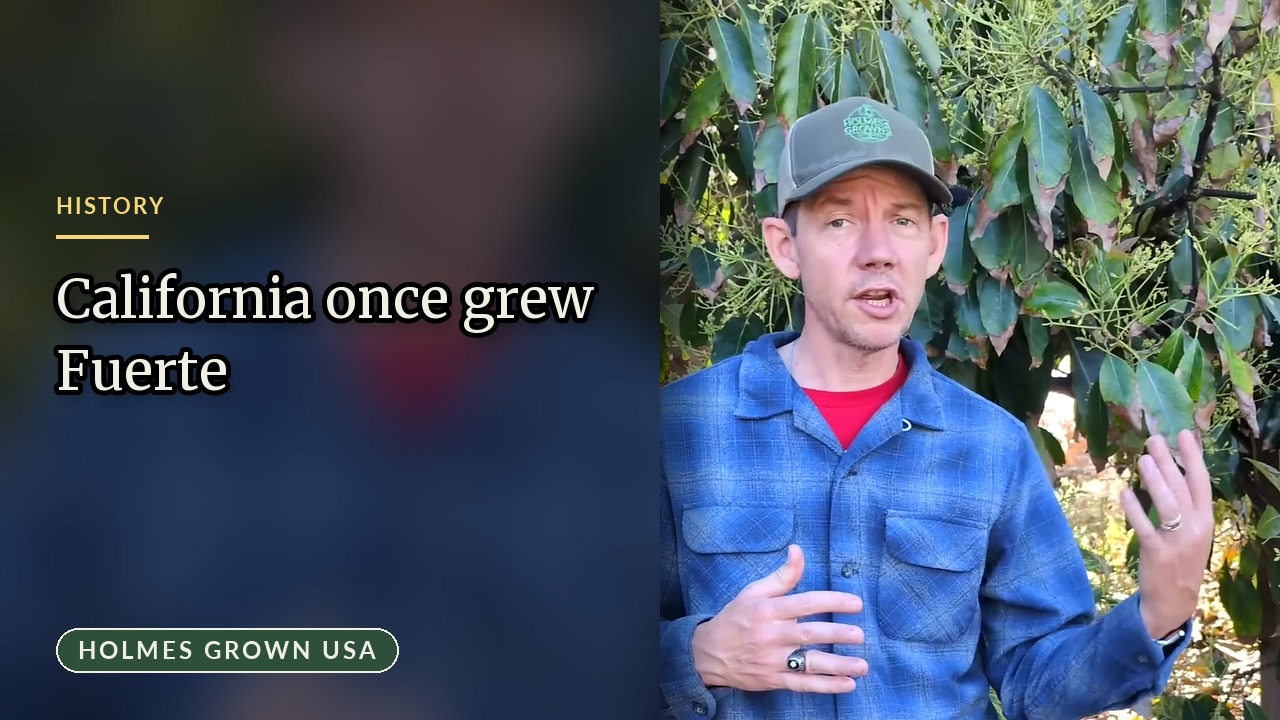
For decades before Hass took over, Fuerte was the undisputed king of the California avocado industry — Hass was patented in 1935 but did not pass Fuerte in volume until 1972. Fuerte was brought from Atlixco, Mexico to Altadena, California in 1911 by Carl Schmidt, and earned its name — fuerte, Spanish for strong — by surviving the devastating freeze of 1913 that killed other imported varieties.
The full story is better than the short version. Schmidt was collecting for West India Gardens, a nursery in Altadena, and took budwood labeled simply “No. 15” from a tree in the backyard of Alejandro Le Blanc in Atlixco, Puebla. The January 1913 freeze killed most of the nursery’s young trees, but No. 15 came through, and nursery owner F. O. Popenoe named it Fuerte for that hardiness. A grower named John T. Whedon reluctantly accepted the trees in place of the varieties that had frozen and planted them near Yorba Linda in 1914. It became the first Fuerte orchard, and Whedon went on to sell fruit to Los Angeles and San Francisco hotels for as much as $12 a dozen.
It differs from Hass in ways you notice immediately:
- Color. Where Hass turns dark purple-black as it ripens, Fuerte stays a vivid, smooth green right through peak ripeness.
- Shape and skin. An elongated, classic pear shape with medium-thin skin that peels cleanly.
- Flavor. Lower water content, a silkier mouthfeel, and a delicate hazelnut finish that many long-time avocado eaters prefer to any other cultivar.
That thin skin is also why you cannot buy one. It makes mechanical packing and cross-country transit difficult, so national chains phased Fuerte out decades ago in favor of thicker-skinned fruit. We went into that trade-off in Hass vs Fuerte: why your grocery store only sells one.
Why did Hass replace Fuerte?
Thin skin was only part of it. On the tree, Fuerte is harder to farm for a steady living. Its fruit set is erratic, and Fuerte groves usually swing between heavy and light years more than Hass groves do. Over 19 years of records through 1982, Hass averaged 7,249 pounds per acre against 4,842 for Fuerte. Hass also has the longest harvest season of any California variety, which suits a market that wants avocados every week of the year.
The shift was gradual and then complete. Hass passed Fuerte in volume in 1972, forty years after its introduction, and by 1990 Fuerte was down to 2% of California production. By the 2011-12 season the whole state’s Fuerte crop was only about 656,000 pounds. That is why a Fuerte from a grove like ours is now a seasonal treat rather than a supermarket staple.
Managing Fuerte trees through autumn
Mature Fuerte trees need close attention to irrigation, canopy structure and hillside fruit load. Fuerte has a more sprawling, spreading habit than upright varieties, so our crew watches branch weight carefully as the fruit sizes up through late autumn — the same reasoning behind staking heavy branches.
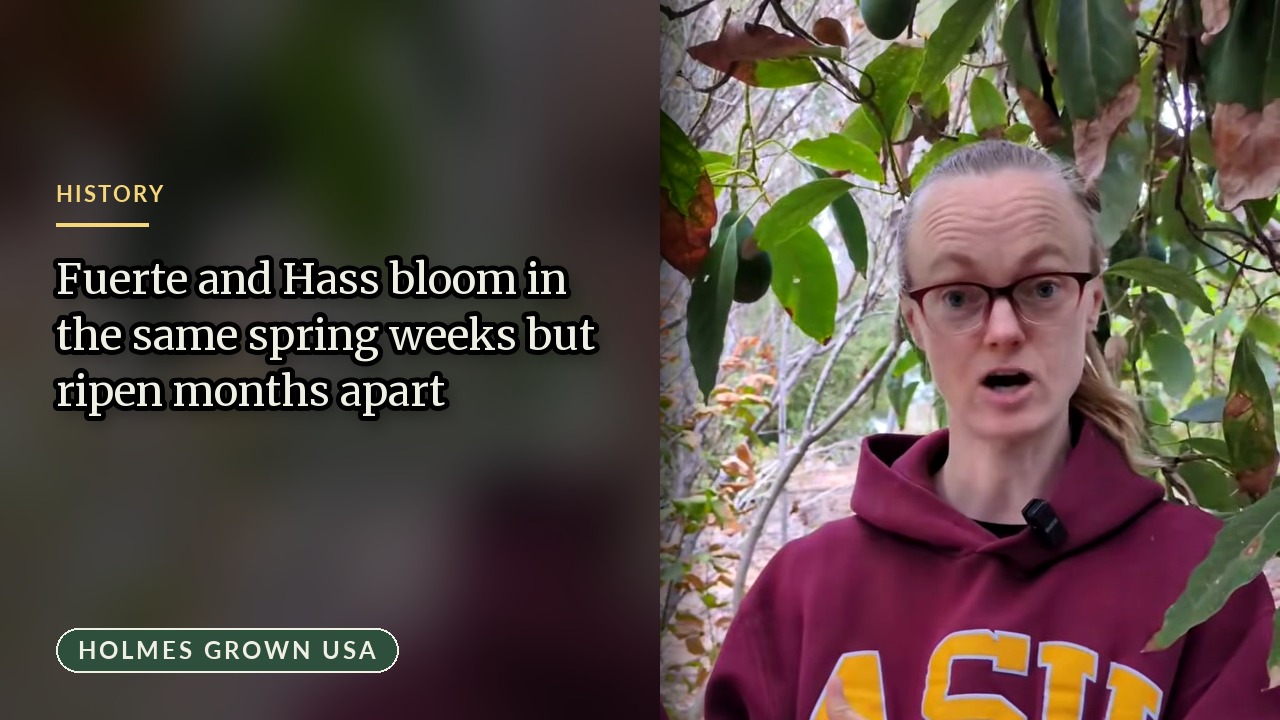
Fuerte is also a Type B variety with famously erratic fruit set, and when spring weather disrupts pollination it is prone to producing seedless avocado cukes. In cool spells the flower timing can fail entirely: Avocado Production in California: A Cultural Handbook for Growers, Book One, records conditions in which Fuerte flowers never opened in their female stage at all, while Hass trees in the same weather completed their normal cycle. Fruit set in Fuerte often improves dramatically when Type A varieties are planted among the trees.
The Fuerte we grew up climbing
Fuerte grows wide rather than tall, with long, strong side branches, which is why a mature Fuerte makes such a good climbing tree. The one in this walk was Kirk’s climbing tree as a boy, and now our own kids climb the same limbs while the fruit sizes up. We told more of that tree’s story in how tough is an avocado tree.
That spread is also the management job. Periodic pruning keeps the skirt off the ground, keeps branches from rubbing in the wind, and lets light into the middle of the tree. Walk a Fuerte next to a Hass and compare how far each has spread: that difference decides your spacing and your picking plan.
What we look for before picking
Fuerte never turns dark, so color will not tell you it is ready. On our trees, the fruit loses its glossy, young shine and takes on a duller, waxy green, and the small speckles on the skin become easier to see. Those are cues, not a test. The reliable check is to pick a few, let them soften on the counter, and taste them before picking more.
Harvest timing and oil content
Fuertes typically reach optimal maturity in November and hang soundly on the tree through the winter, accumulating oil content with every passing week. That is why a Fuerte picked in January eats richer than one picked in November — the tree is doing the work of improving it.
Our harvest runs from November through the winter until the trees give their last fruit.
That matches the variety’s usual window: the handbook’s cultivar table puts Fuerte’s picking season from November to March, after a bloom that runs from February to April. Some Fuerte groves flower over a much longer stretch, occasionally from October to July, and fruit from those off-season blooms can mature in early fall, often with a telltale flat spot on one bottom corner. The trees are fairly cold-hardy, to about 27°F, and the fruit tolerates a few degrees more cold than Hass. We compare the two calendars in Fuerte vs Hass growing season.
Grove-to-table, and how to know when it starts
Alongside packing and shipping, Becca is developing a series of grove-to-table recipes built around Fuerte’s smooth texture. Cooking with a heritage green-skin takes a slightly different touch than working with commercial fruit — the lower water content changes how it behaves in dressings and winter salads.
Because we harvest these trees on a limited seasonal schedule, Fuerte is available only while the trees bear. The harvest alert on any sold-out box, including our 4lb Fuerte box, is the way to hear first when it begins.
This is part of our complete guide to growing avocado trees — time to fruit, height, roots, leaf health, pruning and picking, all in one place.