How to Grow Avocado Trees: A Grower’s Complete Guide
We inherited our family’s avocado grove in November 2024. Kirk had been climbing these trees for about 40 years, but growing them well is a different skill, and most of what we know we have learned since, on our ten-acre commercial grove and the roughly 30 trees on a little under an acre at the house in Escondido. This guide gathers everything we have filmed and written about growing avocado trees. Watering has its own guide, how much water an avocado tree needs, and so do the costs, in what it really costs to run a California avocado farm. Where the science matters, we have checked this guide against both volumes of Avocado Production in California, the growers’ handbooks published by UC Cooperative Extension and the California Avocado Society: Book One (2013) on background, varieties and planting, and Book Two (2015) on watering, feeding, pests, disease, pruning and frost.
Start with a grafted tree, not a pit
We buy our trees from Brokaw Nursery, and most nurseries in mid to southern California carry avocados; elsewhere, ask a local nursery to order one in (three questions we get every week). We do not sell trees ourselves (here is why).
Buy grafted. A seed does not grow a copy of its parent, so every seedling is a new variety and its fruit a gamble (why a seed won’t taste like its parent, seed vs grafted); it is also why we pull up volunteer seedlings under our trees. A grafted tree is a clipping of a known variety joined to a chosen rootstock, old-fashioned horticulture rather than genetic modification (is a grafted Hass GMO?), and the rootstock is picked to tolerate root rot and cope with salty water (what rootstock is). Tolerate is the honest word: the handbook is clear that no rootstock that will take an avocado graft is truly resistant to Phytophthora root rot, only more or less tolerant.
For most of the industry’s history, California trees were grafted onto seedlings of Topa Topa, a Mexican type that sprouts evenly and grafts easily but is very susceptible to both root rot and salt. A technique worked out at UCLA in the 1950s now lets nurseries clone a proven rootstock, rooting a shoot of it in the dark before grafting the fruiting variety on top, and those clonal trees cost about twice as much. Every rootstock is a trade-off. In the handbook’s ratings, Thomas, which came from Escondido, had the best survival in root-rot replant trials but does poorly with salty water; Toro Canyon and the South African Dusa looked like the best choices for salty water; and Duke 7 was among the top yielders in clean soil. Those ratings date from 2002, and the handbook already listed newer selections in trials, so ask your nursery what it grafts onto and why.
Our videos give different numbers for the wait. For grafted trees we have said first fruit in years two to three, or three to five, and our published timeline puts a real crop at years five to seven. The handbook’s version is that most grafted trees start bearing in the third year after planting and reach full production around years eight to ten; here is a five-year-old grafted tree. From seed, our estimates run from five to fifteen years (the pit’s long wait, helping a seedling fruit). The handbook says a seedling can take up to 10 years to bear, or 10 to 15 years just to flower, and some never bear at all. See how long until an avocado tree produces fruit. Small varieties such as the Little Cado (the handbook lists it as Wurtz, also sold as Minicado) and the semi-dwarf Holiday exist, but most small trees are just young, and pruning keeps almost any variety compact (are dwarf avocado trees real?).
Picking the spot: drainage, frost and heat
Drainage matters more than almost anything. Avocado roots have few root hairs and need steady moisture, yet they start dying after about 48 hours in flooded soil even without disease, and root rot is much worse in poorly drained ground (avocados hate wet feet). The handbook’s test is simple: dig a hole 18 inches deep and fill it with water, and if water is still standing the next day, the spot is not good for avocados. It wants soil that drains freely at least three feet down, with no clay, hardpan or rock layer in the way. Where root rot has been, growers replant on mounds about 20 inches high and six or seven feet across.
Cold air runs downhill and pools in low spots, so plant above the frost line. Hass fruit is damaged by about four hours below 29°F, and California gets a damaging freeze about once a decade, so ask the neighbors what their low spots do in a cold winter. That is why our grove’s old plans put the cold-hardy Bacon downhill and Hass higher up (why Bacon went downhill). Heat and wind count too: long spells over 100°F drop fruit, temperatures over 105°F in late May or June can drop nearly all the newly set fruit, and Santa Ana winds can strip a tree almost bare of fruit.
If a freeze does hit, Book Two’s advice is mostly patience. Light damage shows within about a week, but the full extent can take months to appear, so the handbook says not to prune until regrowth shows what is really dead, at least six months after the freeze; wood that looked killed has put out vigorous growth later in the season. Paint or whitewash the trunk and big limbs that face south and southwest if they will still be bare when hot weather comes, water less, because a leafless tree uses less and root rot thrives in wet soil, and hold back fertilizer on badly damaged trees, where it only forces more sucker growth.
Planting: timing, spacing and shape
Our own videos make the case for October: past the summer scorch, and early enough to settle in before frost (when to plant, why October works). The handbook leans the other way. It says you can plant any time frost is not a threat, but that spring is best: roots usually flush in May, so it wants trees in the ground in March or April, and a summer planting needs water every two or three days without being drowned. Elsewhere, start with your USDA hardiness zone.
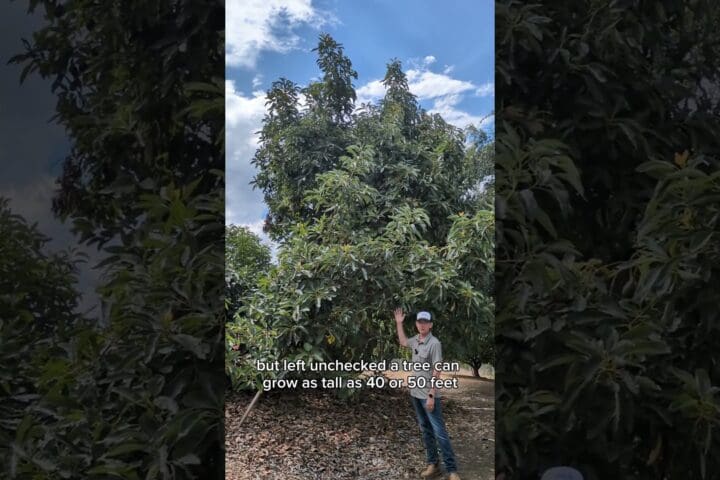
Give the tree room. Our original plans show trees at 15 by 15 and 25 by 25 feet (what the old planting plans teach us). When we replant, we will start by replacing trees at the same density, and once the new trees are in we plan to plant closer. The handbook’s traditional spacing is 20 by 20 feet, 109 trees an acre. Many groves went in at 15 by 20 with a plan to remove every other tree once they crowded, which many growers never did, leaving tall trees that fruit only at the top. Upright varieties such as Reed can go as close as 8 to 10 feet and be kept 10 to 12 feet tall. Fuerte spreads wide, Hass grows a little more upright, and a GEM, which the handbook describes as open and spreading, can be pruned to grow almost straight up (Hass vs Fuerte vs GEM); no two trees look alike (what an avocado tree looks like), but left alone they all get big (how tall avocado trees grow). Young trees are the most vulnerable to gophers (our newest tree, a Reed).
The handbook’s planting steps are worth following even for one backyard tree. Dig the hole about as deep as the root ball and two to three times as wide; a deeper hole backfilled with loose soil lets the tree settle and can sink the graft union below the soil line. Never lift a young tree by its trunk, which can snap it at the graft. Set the top of the root ball slightly above the surrounding soil, backfill with the native soil and no compost or manure (manure has killed young roots with salt and ammonia), and leave a shallow basin with the top of the root ball uncovered so it takes water. Mulch with straw or wood chips, wrap the trunk against sunburn for the first year, and give the tree about 5 to 10 gallons a week split into two or three waterings, never letting the root ball dry out. The handbook counts too much and too little water as probably the most common reasons trees fail at planting.
Once a tree is established, watering is a subject of its own (how much water an avocado tree needs), but Book Two’s core rules fit in a paragraph. Avocados use water all year, and in a dry winter growers never stop irrigating. Most of the feeder roots sit in the top 8 to 10 inches of soil, so the handbook says to water when 30 to 50 percent of the water available in the root zone has been used, at the low end on fast-draining hillside soils, and to check with a tensiometer or by digging and squeezing a handful of soil rather than trusting a timer set once a year. Soil type changes how often you water, not how much; the total is driven by the weather. For scale, its figure for a mature tree at 20 by 20 feet in Escondido is about 57 gallons a day in July, including a little extra to leach salt, and about 20 in January. That is daily use, not a daily watering. Missing irrigations for one to two weeks can start the fruit dropping.
Flowers, pollination and fruit set
Every avocado flower opens twice, first as a female and later as a male. Type A varieties such as Hass and Reed are female in the morning; Type B varieties such as Fuerte and Bacon are female in the afternoon. An A flower opens female one morning, closes, and reopens as a male the afternoon of the next day; a B flower is female one afternoon and male the next morning. Every flower has both parts, so A and B describe timing, not male and female trees. Planting both puts pollen where it is needed, which is why our Hass grow alongside Fuerte and Bacon (Type A and Type B, is Reed Type A or B?). A lone tree still sets fruit. In cool spring weather the schedule slips, so one tree carries female and male flowers at the same time and pollinates itself; that is how big blocks of Hass alone still crop well, and why the handbook tells home gardeners they need not plan for cross-pollination. A Type B nearby can still add fruit, especially after a cool spring: in one study Hass trees next to Type B pollinizers averaged about 205 fruit a tree over four years, against 54 for trees 15 rows away.
Insects carry the pollen: mostly bees, though flies arrived first at our young Reed’s first bloom. We think California poppies full of honeybees helped load one tree, and we have tried planting sunflowers. Poor weather for fruit set can leave seedless cukes, small, narrow fruit that a pollen tube started growing before fertilization was ever completed. If a healthy tree will not fruit, we check pollination, then water and nutrients (two things we check first); if it will not bloom, water comes first (tree not blooming?). The handbook agrees that drought stress delays and thins the bloom, and adds that a tree coming off a very heavy crop may not flower at all. In spring, older leaves droop just before the blossoms, Reed buds look rounder and tighter than Hass, and you can soon tell a baby Hass from a baby Fuerte. Baby fruit pressed against a branch scars, so we move young Reeds where we can.
A few handbook facts put all this in perspective. Flowering is triggered by cool weather, not day length, and next year’s flower buds form in late summer, usually August, on the sunny outer shoots of the canopy. A mature tree can open up to a million flowers, about 150 to a Hass flower cluster. Honeybees do nearly all the pollinating in California: in a 1955 cage test, Hass trees without bees set 5 fruit against 284 with them, and most bees work only one to three trees. The usual advice for groves is one to two strong hives an acre. Weather decides the rest, and below about 60°F there may be no fruit set at all.
Feeding, mulch and the soil
A mature tree gets three feedings from us: about 6 pounds of triple 15 in late February or early March, then about 3 pounds of calcium nitrate in June and 3 more in September, spread toward the drip line (when to fertilize). That is, pound for pound, the hand-applied schedule Book Two gives new growers: about 1.8 pounds of actual nitrogen a tree a year, inside the 1.5 to 2 pounds it says Hass generally needs. The handbook’s way to fine-tune it is leaf analysis, 40 leaves from spring-flush shoots without fruit, picked from August to October, and it warns against putting zinc on every year without a leaf test showing the need. Starting on soil amendments and replacing all 1,050 sprinkler heads on the grove with pressure-compensating ones are the changes we credit for a loaded year (what changed in a year). Book Two backs the sprinkler half: in an Escondido trial, pressure-compensating emitters held 92 percent uniformity for two years, and poor pressure regulation, which forces a grower to overwater most trees so the driest get enough, is one of the main causes of wasted water in California groves.
Most of our mulch grows on the trees. We do not rake the duff, the leaf layer means almost no weeds under our trees, prunings stay on the grove floor, and a truckload of wood chips through ChipDrop cost us a $20 tip. Brown leaf tips usually mean salt, not hunger: Book Two says tip-burn is not a nutrient deficiency but chloride building up in the leaf tips, usually from salty water, too little leaching or too much manure, and it tends to show in September and October. Watering a little beyond what the tree uses, so salt is leached below the roots, is the only way to get it out of the root zone. A new watering schedule plus gypsum brought one Fuerte back to a clean green flush. We stopped spraying Roundup, but the weeds still have to go: weeds harbor persea mites and other pests, and Book Two lists weeds among the persea mite’s alternate hosts to remove, so we now control them with OMRI-listed products (weeds and persea mites).
Leaves, pests and disease
New leaves come out red or bronze and turn green, and that flush is one of the best signs a tree can give (why new leaves are red, a quick leaf tour, our leaf health guide). Our worst pest has been the persea mite, which was found in San Diego County in 1991 and within two years was on almost every avocado leaf in the county: small round brown spots on the underside of the leaf, each under a patch of dense, silvery webbing, that show through on top, and in a bad year a stripped tree with small, sunburned fruit (what persea mites did to one tree). Instead of spraying, we ordered a hundred sachets of predatory mites, about 10,000 in each, and hung them dry and in the shade. Weeks later the new leaves were clean, though we cannot yet prove the predators were why.
Book Two treats persea mite as one of the two key avocado pests, alongside avocado thrips. Numbers are lowest around March, build on the spring flush, peak in July and August, and crash after several days in a row over 100°F with low humidity. There is no research-based threshold for spraying. Its cultural advice matches what we have landed on: remove weeds and other host plants nearby, keep trees well watered, do not overfeed (quick-release nitrogen raises mite numbers), keep road dust down because dust weakens the predators, and whitewash trunks and big limbs if leaf drop leaves them exposed to the sun. For releases it suggests starting when about half the leaves have mites, at about 2,000 predators a tree, and it warns that the mites’ webbed nests keep most predators from being highly effective, which fits our own hard-to-prove result.
Squirrels get a trap and some decoy fruit on the ground (squirrels in the grove). The handbook’s squirrel section covers the California ground squirrel, which it says climbs trees but does not seem to eat the fruit; its harm is burrows that undercut banks and roots, gnawed drip lines and injured ankles for pickers, and the advice is to act when even one or two turn up. Gophers are the bigger threat to young trees: they girdle roots or the crown below ground, often unseen until the tree is beyond saving, and the handbook notes that drip and mini-sprinklers favor them by keeping the soil moist. Root rot, caused by Phytophthora cinnamomi and still the most important disease in California avocados, shows as small, pale leaves that wilt even when the soil is wet, dieback that leaves bare branches and a see-through canopy, and scarce feeder roots that are black and brittle (is it root rot?), though compacted soil and drought can look similar (how to save a dying avocado tree); a tree too far gone is replaced on a more tolerant rootstock. The handbook warns that replanting infected ground is not as simple as switching rootstocks: it adds a mound, a wood mulch three to four inches deep kept off the trunk, 10 to 20 pounds of gypsum per tree, and careful watering with the young trees on their own irrigation block.
Book Two’s root rot chapters add the day-to-day management. Good irrigation is the most important control: as little as three days of saturated soil can set roots up for infection, and the handbook is blunt that adding water to a wilting, root-rotted tree only makes it worse. Coarse organic mulch (Book Two suggests at least 4 to 6 inches, kept back from the trunk) and gypsum under the canopy help, and so does keeping infested soil and water from traveling on boots, tools and equipment. Phosphonate treatments, timed for when a leaf flush is about three-quarters grown, usually around May and August, strengthen the roots’ own resistance, but they cannot eradicate Phytophthora from a grove; root rot has to be managed for the life of the trees. Salt makes it worse, one more reason leaching matters.
Pruning, staking and protecting the fruit
To bring a big tree down without losing a crop, we take one of its four or five largest branches each year, often called the Israeli method (pruning one branch a year). Book Two describes it the same way: divide the tree into five main branches and cut one a year back to a two-foot stub, starting on the southwest side, so the work is done from the ground and the tree never goes out of production. At the commercial grove, summer pruning is light and heavy cuts wait for early spring; the house trees mostly grow wild (what July looks like). Timing matters because next year’s flowers form on the sunny outer shoots in late summer, and the handbook warns that hedging late in the season cuts many of them off. Book Two says the same: prune in spring, not after the summer flush; in its stumping trial, trees whose follow-up pruning waited until October lost most of their fruiting wood.
Book Two is also frank that pruning trials have not been shown to raise yield per acre. The reasons to prune are lower, safer picking and better spray coverage, and heavy cuts are a trade: stumping takes a tree out of production for about two years. It says not to paint sealant on big cuts, since sealant keeps the fresh wood too moist and can increase trunk rot, but to whitewash or paint newly exposed trunks and limbs white straight away, because avocado bark sunburns easily. Its simple recipe is white interior latex paint diluted half and half with water.
Shade is the thread. Fruit hangs inside the canopy, so a loaded tree can look empty; fruit on the sunny edge often burns while fruit inside makes it to harvest, and fruit under a branch that never flushed never ships. Read sunburn and water sprouts before opening up a canopy. We also snap off branches rubbing young fruit and dead wood that bruises it.
Fruit that touches the ground cannot be sold (why ground-dropped fruit can’t be sold), so heavy limbs get propped. One loaded year took roughly 600 wooden stakes (why our grove needed 600 stakes), mostly for our old, sprawling trees (the stakes that hold them up). A stake carries the weight so the branch keeps growing (staking a loaded branch, fruit on the mulch, wooden props under the branches), and we pick the lowest fruit first.
Old trees and second chances
We are slow to pull a tree now. Two at the house got pink ribbons for removal, then pushed new growth, and our irrigation calculator showed they had the wrong sprinklers. Another tree tagged for removal came back into bloom, and an old tree full of dead wood showed red flush on its shaded side. The Fuerte Kirk climbed as a kid still fruits lying on its side, like the sideways Fuerte our boys climb. See caring for fallen or hollowed-out trees, Fuerte tree care and life on our family grove.
From bloom to harvest: drop, overlap and alternate bearing
A tree sets far more fruit than it keeps. We have used about 1 percent of flowers as a rough rule (a Fuerte season longer than a year), but the handbook’s figure is far lower: fewer than 0.1 percent of flowers hold to maturity, and a good crop of 200 fruit on a tree is about 0.02 percent of its flowers. One of our trees went from an estimated thousand babies to maybe 250 keepers. That early-summer shedding is what growers call the June drop, and heat adds to it, since temperatures over 105°F in late May or June have been known to drop almost the whole young crop (avocados on the ground after a heat wave), so a loaded tree is not a forecast, whether it shows about 300 young fruit in late May or at least 750 in March.
Mature fruit hangs for months, so a tree can carry two harvests at once; that is how we find missed jumbos beside the new crop, and one reason sizes vary on the same tree. Some varieties, Fuerte above all, swing between heavy and light years (why a tree skips a year). The handbook’s explanation is that shoots carrying fruit do not flower the next spring, so a heavy crop leaves fewer flowering shoots for the following year; for Hass it suggests picking at least a third of the crop before April to help the next bloom. Our favorite Fuerte may carry something like 80 percent less after a loaded year (alternate bearing as survival), while an OG Fuerte full of blossoms and bees promises a big one.
Harvest: when and how to pick
For decades California law set the maturity bar at 8 percent oil by weight, and we still use it as our rule of thumb for Hass: on our trees it arrives around March, and oil keeps climbing the longer the fruit hangs (the 8% oil rule). The handbook notes that the 8 percent law itself was overturned by a Florida lawsuit in 1973, so read the number as history and a rule of thumb rather than today’s legal test; the principle, that fruit must be mature before it is picked, has not changed. Growers read the skin too (shiny vs dull avocados, if you know, you know).
Cut, don’t yank: pruners protect both branch and fruit (picking with pruners, harvesting without damaging branches). High fruit comes down on a pole picker (picking from the top of the tree, repairing a vintage pole picker); climbing the tree is quicker, and not something we recommend. After picking, turn to choosing, ripening and using avocados; for how these trees got here, see the history of California avocados.
If your own tree is still a few years from its first crop, ours can fill the gap. Our 4lb and 6lb Hass boxes ship free, picked the week they go out, and between harvests you can join the waitlist on either page and we will email you when fruit is back.
Every post in this guide
Here is everything we have published on this subject so far, grouped by topic. We add new posts as we film them.
Choosing, planting and spacing a tree
- Three Avocado Tree Questions We Get Every Week: Water, Nurseries and Time to Fruit
- Do We Sell Avocado Trees? No, and Here Is Where We Buy Ours
- Why an Avocado Grown From Seed Won’t Taste Like Its Parent
- Seed vs Grafted Avocado Trees: Why We Only Plant Grafted
- Planting an Avocado Pit? Expect a 7-to-10-Year Wait for Fruit
- Can a Seed-Grown Avocado Tree Fruit? Three Ways to Help It Along
- Why We Pull Up Volunteer Avocado Seedlings Under Our Trees
- Is a Grafted Hass Avocado GMO? No: How One Tree’s Clones Fill Every Grove
- What Is Avocado Rootstock? The Half of the Tree Chosen to Resist Root Rot and Salt
- What a Five-Year-Old Grafted Avocado Tree Looks Like
- Are Dwarf Avocado Trees Real? Little Cado, Holiday and the Pruning Option
- Can You Grow an Avocado Tree in Las Vegas? Frost, Summer Heat and Cold-Hardy Varieties
- When to Plant an Avocado Tree in California: Why October Works
- When to Plant an Avocado Tree: Why October Works in California
- Doubling the Spacing: What Our Original Planting Plans Teach Us About Replanting
- Hass vs Fuerte vs GEM: How Avocado Varieties Grow Differently
- What Does an Avocado Tree Look Like? Tall, Short, Bushy and One Growing Sideways
- Our Newest Avocado Tree Is a Reed: Bare Ground, a Gopher and a Lost Fruit
- How Long Until an Avocado Tree Produces Fruit?
- How Tall Do Avocado Trees Grow?
- Avocado Tree Care: Why You Should Not Grow Plants Under the Canopy
Flowers and pollination
- Type A and Type B Avocados: Why Hass Needs a Fuerte or Bacon Nearby
- Is a Reed Avocado Type A or Type B? The Short Answer
- Healthy Avocado Tree but No Fruit? Two Things We Check First
- Avocado Tree Not Blooming? Start With Water, Then Think About Pollinators
- California Poppies and Honeybees: Why We Think This Avocado Tree Is Loaded
- Our Youngest Reed Avocado Tree Blooms for the First Time
- Reed Avocado Blossoms Up Close: Rounder, Tighter and Different From Hass
- Why Avocado Leaves Droop in Spring: A Sign the Blossoms Are Coming
- Baby Hass vs Baby Fuerte: Telling Young Avocados Apart on the Branch
- Our First Real Reed Avocado Crop, and Why We Move the Baby Fruit
- How Planting Sunflowers Boosts Avocado Tree Pollination and Fruit Set
- What Is an Avocado Cuke? Why Some Avocados Grow Completely Seedless
Feeding, mulch and soil
- When to Fertilize a Mature Avocado Tree: Our Three-Step Schedule
- What Changed in a Year: 1,050 New Sprinkler Heads, Soil Work and a Loaded Grove
- Don’t Rake the Duff: Four Reasons We Leave Avocado Leaves Where They Fall
- Why There Are Almost No Weeds Under Our Avocado Trees: Leaf Mulch
- Why We Leave Prunings on the Grove Floor Instead of Hauling Them Away
- Free Wood Chips Through ChipDrop: A Truckload of Mulch for a $20 Tip
- From Brown Tips to a Green Flush: How Our Fuerte Tree Bounced Back
- We Stopped Spraying Roundup, but the Weeds Still Had to Go: Weeds and Persea Mites
- Storm Aftermath in the Grove: Erosion, Fallen Fruit, and Soil Recovery
Leaves, pests and disease
- Why New Avocado Leaves Are Red: What the Flush Does for the Tree
- Red, Round and Spotted: What a Quick Avocado Leaf Tour Shows
- From Full Canopy to Bare Branches: What Persea Mites Did to One Avocado Tree
- Finding Persea Mite Webbing and Ordering a Million Predatory Mites
- Polka-Dotted Avocado Leaves: Fighting Persea Mites With Predatory Mites
- Did Predatory Mites Work? Checking Our Avocado Leaves Weeks Later
- Squirrels in the Avocado Grove: What We Have Tried
- Bare Branches and a Thinning Canopy: Is It Avocado Root Rot?
- When a Root Rot Tree Comes Out: Replanting on Resistant Rootstock
- Avocado Tree Leaf Health: Identifying New Growth, Leaf Shapes, and Pest Signs
- How to Save a Dying Avocado Tree: Diagnosing Root Compaction and Soil Stress
Pruning, staking and protecting fruit
- Pruning a Large Avocado Tree One Branch a Year: The Israeli Method
- What July Looks Like on an Avocado Grove: More Water, Light Pruning
- Where Are All the Avocados? Why a Loaded Tree Looks Empty From Outside
- Which Baby Avocados Make It to Harvest? Sun, Shade and Small Feet
- Sunburnt Avocados: Why Fruit Without Leaf Cover Never Ships
- Wind Rub on Avocados: Why We Snap Off Branches Touching Young Fruit
- Snapping Off Dead Branches Before They Bruise the Fruit
- Not the Kind You Eat: Why Our Avocado Grove Needed 600 Stakes
- Big, Sprawling Avocado Trees and the Stakes That Hold Them Up
- Staking a Loaded Avocado Branch So It Keeps Growing
- Fruit on the Mulch Can’t Be Sold: Why We Prop Up Loaded Avocado Branches
- Why Avocado Groves Are Full of Wooden Props Under the Branches
- A Foot From the Dirt: Picking Low Avocados Before They Touch the Ground
- Avocado Tree Sunburn and Pruning Water Sprouts: How to Protect Grove Yields
- How to Stake Avocado Tree Branches: Protecting Fruit and Guiding Canopy Growth
- Fallen Avocados and Farming Regulations: Why Ground-Dropped Fruit Can’t Be Sold
Old trees and second chances
- Pink Ribbons on Avocado Trees: Giving Struggling Trees a Second Chance
- Tagged for Removal, Now in Bloom: The Avocado Tree We Wrote Off
- Is Our Old Avocado Tree Dying? New Flush and a Heavy Pruning Plan
- How Tough Is an Avocado Tree? The Fuerte Kirk Climbed as a Kid
- How to Care for Fallen or Hollowed-Out Avocado Trees: A Legacy Grove Guide
- Fuerte Avocado Tree Care: Managing Aging Trees, Trunk Rot, and Heavy Branch Support
Fruit set, fruit drop and alternate bearing
- Next Year’s Blossoms, This Year’s Fruit: Why a Fuerte Season Runs Past 12 Months
- A Thousand Baby Avocados, Maybe 250 Keepers: Counting Natural Fruit Drop
- We Just Watched a Baby Avocado Fall: Why the June Drop Is Normal
- Avocados on the Ground After a Heat Wave: What Hot Days Do to the Crop
- A Loaded Tree Is Not a Forecast: Why We Won’t Guess Next Year’s Avocado Crop
- Next Year’s Avocados Are Already on the Tree: A Late-Spring Crop Check
- At Least 750 Avocados on One Tree: Estimating a Loaded Tree in March
- Two Harvests on One Avocado Tree: Why We Tread Carefully in Bloom
- The Ones We Missed: Last Season’s Jumbo Hass Beside This Year’s Crop
- Why Avocados on the Same Tree Grow to Different Sizes
- Heavy Crop, Light Crop: Why Your Avocado Tree Skips a Year
- Alternate Bearing as Survival: Why a Fuerte Tree Floods the Forest With Fruit
- Blossoms and Bees on an OG Fuerte: Reading an Alternate-Bearing Tree
- June Drop in Avocados: Testing Myths About Seedless Fruit and Crop Loss
- Avocado Tree Dropping Fruit: Why Avocados Shrivel and Sunburn
- Fuerte vs Hass Avocado Growing Season: Why Bloom Dates Do Not Predict Harvest
Harvest
- The 8% Oil Rule: When California Hass Avocados Can Be Picked
- If You Know, You Know: Reading Avocados on the Tree Like a Grower
- Cut, Don’t Yank: Picking Avocados With Pruners So They Last Longer
- Monster Fuerte at the Top of the Tree: Pole-Picking the Biggest Avocados
- No Ladder, No Pole Picker: Climbing an Avocado Tree to Pick
- Shiny vs Dull Avocados: How to Tell Fruit Maturity on the Tree
- How to Harvest Fruit Without Damaging Tree Branches: Proper Stem Snapping Techniques
- How We Pick Avocados from the Top of the Tree
- How to Repair and Maintain a Vintage Avocado Pole Picker Tool
- Hass Avocado Harvest Guide: Managing Late Season Fruit and Summer Heat