How Tall Do Avocado Trees Grow?
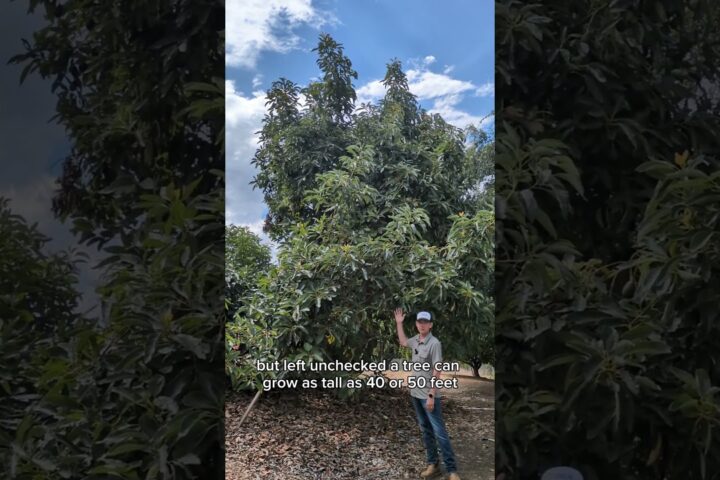
Short answer: 40 feet or more, and an unpruned Hass can reach 50 to 60 feet, if nobody stops it. Most working groves, ours included, keep trees far lower than that so the fruit can be picked safely.
That surprises people who have only seen an avocado tree in a garden centre pot. Left completely unchecked, Persea americana is not a shrub with ambitions — it is a forest tree, and it spends its whole life reaching for light.
Which is exactly why almost no working grove lets it happen.
What we actually keep ours at
We trim consistently, and the target is around fifteen feet.
That number is not about tidiness. A tree kept at a workable height is one you can harvest efficiently, and efficiency is the whole game on a small family farm. It also keeps the fruit quality up year after year, because light reaches through the canopy instead of only landing on the top.
Left to run, the same tree would carry its best fruit thirty feet in the air, where getting it down safely becomes a slow and awkward job. We wrote about picking avocados from the top of the tree, and the pole picker involved, which tells you what height costs you at harvest.
How quickly they get there
Height arrives with maturity. Put a two-year-old tree beside a mature one and the difference is startling — the young tree still looks like something you could manage with hand shears, and the mature one plainly does not.
Grafted trees usually start bearing in their third year and reach full production around years eight to ten, putting on height the whole way. By ten to fifteen years a tree is significantly taller and carrying a dense crop high in the canopy. If you are planting now and wondering about the timeline, we went through it in how long until an avocado tree produces fruit.
Bringing a tall tree back down
This is where people get into trouble. Cutting a tall avocado back hard is not a weekend decision.
Avocado bark sunburns badly when it is suddenly exposed, and in Southern California that damage is real and fast. Height has to be managed gradually and consistently rather than corrected in one go — we covered the risk in avocado tree sunburn and pruning water sprouts.
The grower handbook backs up the gradual approach. Stumping a tree back to a 4 to 5 foot trunk takes it out of production for about two years, and the stumps need whitewash or white paint straight away. Cutting back to 15 to 20 feet of bare limbs, called staghorning, is not generally recommended in California, partly because those high limbs are hard to paint and tend to burn. The gentler option it describes is the Israeli method: divide the tree into about five main branches and cut one back each year, so the tree never goes out of production. And in a San Diego County trial, stumped trees trained to a central leader and topped at 14 feet could be harvested entirely from the ground with picking poles, which is close to the height we aim for.
Why does pruning timing matter?
Height is only half of it; when you cut matters too. Avocado flower buds form in late summer, usually in August, and the flower clusters grow on the outer, sunlit surface of the canopy. Hedging or shaping late in the season removes many of the shoots that were about to flower, which means fewer avocados the following spring. The UC handbook Avocado Production in California flags exactly this problem for growers who prune late. Its pruning chapter is blunter: avocados should not be pruned after the summer flush, and spring is the best time. In one San Diego County trial, a block pruned in October lost most of its fruiting wood.
The same handbook lists “the tree is too large” among the long-standing complaints about Hass: big trees add to picking costs, picking at height can be hazardous, and spraying gets difficult. Its advice for groves on steep slopes is to run a topping and pruning program to keep height under control. That matches our experience — steady, modest cuts beat one dramatic correction.
Do some avocado varieties stay smaller?
Yes, within limits. Hass and Fuerte both grow into large, spreading trees. Reed, Lamb Hass, Gwen and Bacon grow more upright, which makes them easier to hold in a narrow space; some Reed growers plant trees only 8 to 10 feet apart and keep them 10 to 12 feet tall.
For small gardens, Wurtz is the classic choice. It is a naturally small tree, sometimes sold as Littlecado, Minicado or “Dwarf,” with green fruit from May to August, though it is cold-tender, rated to about 31°F. Holiday is a semi-dwarf that stays smaller still and carries very large green fruit in December and January. Our guide to avocado varieties covers how the fruit of each compares.
How far apart should avocado trees be planted?
The traditional commercial spacing in California is 20 by 20 feet, which works out to 109 trees per acre. A closer 15 by 20 feet (145 trees per acre) is also common, on the understanding that every other tree comes out once the canopies touch. For spreading varieties like Hass, the handbook’s variety table suggests roughly 50 to 100 trees per acre, while upright varieties can go denser. At home the same rule holds: the closer you plant, the more pruning it takes to stop trees racing each other upward.
If you are growing one at home
Decide early what height you are willing to work at, and manage to it from the beginning. Keeping a tree at a sensible size is straightforward. Rescuing one that has already hit thirty feet is not.
Give it room as well. Trees planted tight compete for light and stretch upward faster than ones with space. Commercial growers learned this the hard way: many groves planted 15 by 20 feet were meant to have every other tree removed as they grew, and where nobody thinned them, the crowded trees ended up fruiting only at the top. And leave the ground beneath alone — avocado feeder roots sit close to the surface, which is why you should not grow plants under the canopy.
If you would rather have the avocados without owning the ladder, our 4lb and 6lb Hass boxes are picked to order from trees we keep at a height we can actually reach. They ship free. Until the trees are picking again, the avocado scoop, the Hawaiian shirt and our hats ship year-round.
This is part of our complete guide to growing avocado trees — time to fruit, height, roots, leaf health, pruning and picking, all in one place.