Hass vs Fuerte vs GEM: How Avocado Varieties Grow Differently
Not every avocado tree grows the same shape. The variety makes a big difference. Fuerte trees tend to spread out wide. Hass trees grow a little more upright. And a variety like the GEM, when it is properly pruned, grows almost straight up.
If you are choosing a tree for a yard, or trying to understand why two trees in the same grove look nothing alike, growth habit is one of the first things worth knowing.
Fuerte: the spreader
Fuerte is the variety the California avocado industry was built on (the original tree came from Atlixco, Mexico, in 1911), and its trees reach outward much more than a Hass does. The UC growers’ handbook describes the Fuerte tree simply as large and spreading. That broad, spreading canopy is part of their character. It also means long, heavy limbs that can sag low as they age and load up with fruit, which is why we spend real time on supporting heavy Fuerte branches on our older trees.
A spreading tree needs room. Plant a Fuerte too close to a fence, a path or another tree and you will be cutting it back for the rest of its life.
Hass: more upright
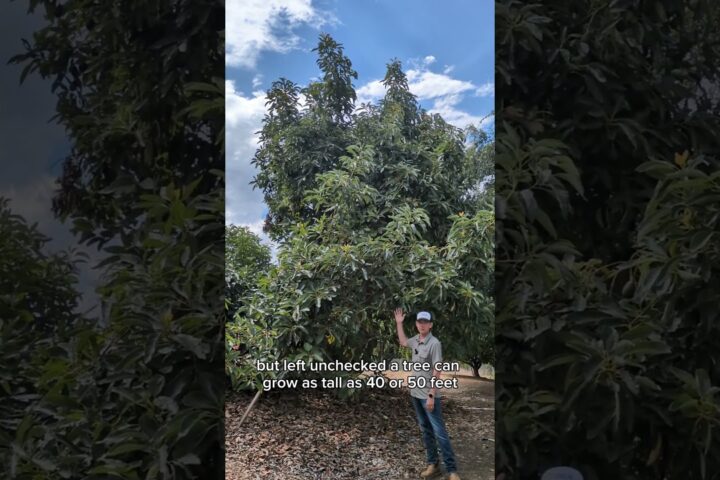
Hass grows with a more upright habit than Fuerte — still a big tree, but less inclined to sprawl sideways. It is not a narrow tree, though: the handbook calls the Hass canopy moderately spreading and says an unpruned Hass can reach 50 to 60 feet. Left alone, any avocado will keep climbing; we explain in how tall avocado trees grow why we keep ours well below their natural height.
The Hass in this video is also a great climbing tree, and we know that first-hand because our boys climb it, or at least attempt to. Our oldest can get himself up. Our youngest still needs a little help.
GEM: grows up, not out
The GEM is a newer variety from the University of California breeding program at Riverside, selected at the Lamb Ranch and released to nurseries in 2003. Like Hass, it is black-skinned, has an A-type flower and ripens over roughly the same season. The fruit runs about 7 to 11 ounces. Its best-known trait is that cut flesh stays green much longer than Hass does, and it tends to alternate-bear less than Hass.
On shape, one caveat. The UC growers’ handbook actually describes the GEM tree as open and spreading. What we see is that, with proper pruning, a GEM can be trained to grow extremely vertical — the pruning is doing a lot of the work. A tree kept narrow is easier to manage and pick, but do not expect a GEM to stay narrow on its own.
Why does tree shape matter?
Because it affects almost everything that happens later. Shape decides how far apart trees need to be, how much pruning they will want, and how much of the fruit ends up high or out of reach. A wide Fuerte and a narrow GEM ask for very different care, even in the same row.
The handbook’s cultivar chart, which dates from 1996, gives a sense of the difference: about 50 to 100 trees per acre for spreading Hass and Fuerte, against roughly 100 to 140 for upright varieties such as Reed and Lamb Hass. It also notes that Hass, with its spreading growth, is hard to keep at close spacing without pruning away the wood that bears fruit.
If you do prune to shape a tree, the handbook’s second volume (Book Two, 2015) has two useful rules. Prune in spring, and not after the summer flush: in one UC trial, stumped trees pruned in October lost most of their fruiting wood for the next year. And keep expectations realistic: because Hass flowers on the sunlit outside of the canopy, pruning trials have not shown higher yield per acre. The reasons to prune are easier and safer picking and better spray coverage. Limbs newly opened to the sun should be whitewashed, because avocado bark sunburns easily. One gradual approach is in pruning a large avocado tree one branch a year.
It also affects harvest. The taller and wider a tree gets, the more of its crop ends up where only a pole picker can reach it — and we have written about picking avocados from the top of the tree for exactly that reason.
Have a question about your own avocado tree? Leave it in the comments on the video and we will do our best to answer. And if you would rather someone else did the climbing, our 4lb and 6lb Hass boxes ship free in season, with a waitlist on each page when the trees are between harvests. Until the trees are picking again, the avocado scoop, the Hawaiian shirt and our hats ship year-round.
This post is part of our guide to growing avocado trees.