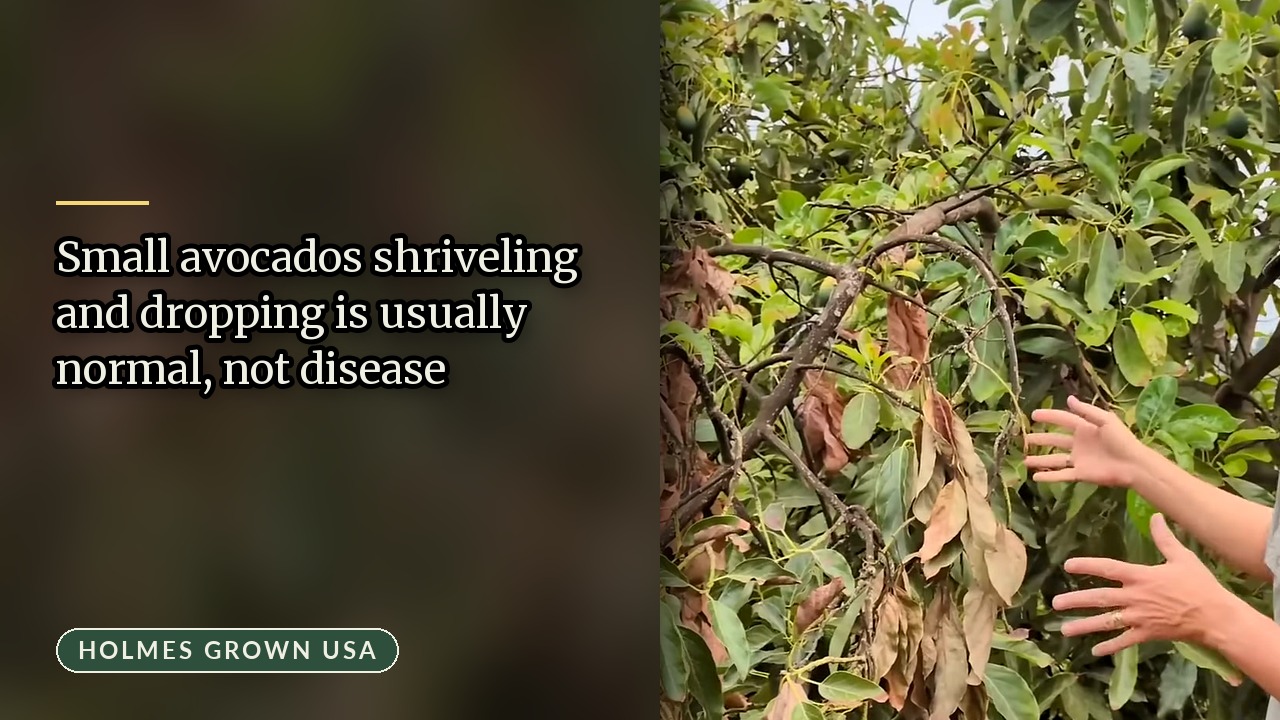
June Drop in Avocados: Testing Myths About Seedless Fruit and Crop Loss
June drop in avocados is the natural shedding of young fruit in early summer, and a carpet of baby avocados under the tree is usually not a sign that anything is wrong. Avocado trees start far more fruit than they can carry and let most of it go; heat, water stress and wind can make the drop bigger in some years.
This sudden loss of baby avocados often surprises homesteaders, backyard gardeners, and commercial avocado growers alike, and it leads to questions about tree health, irrigation, or seed development failures.
To address common questions about early season avocado fruit drop, we conducted a field experiment in our Escondido orchard. Here is a breakdown of why June drop occurs, what happens inside young avocados during development, and what growers can expect as their harvest matures.
Testing the Seedless Avocado Myth
A persistent hypothesis among hobby growers suggests that avocado trees drop fruit primarily because the blossoms were unpollinated or failed to develop a seed core. To test this theory in our orchard lab, we collected recently dropped baby avocados from our Reed avocado trees.
Using basic field cross-sectioning, we examined the inner cavity of multiple dropped avocados at various early growth stages.
Key observations from our field test included:
- Intact Seed Cavities: Every dropped baby avocado contained a visible, miniature developing pit.
- Soft Tissue Density: Early-stage seeds possess soft tissue that cuts easily, which occasionally leads gardeners to misidentify tiny seeds as empty pulp.
- Uniform Shedding: Seed formation was consistent across dropped specimens, showing that these fruit had been pollinated and fertilized, so a lack of pollination was not the driver of fruit shedding in this block.
Read nextAvocados on the Ground After a Heat Wave: What Hot Days Do to the Crop
Is a Dropped Baby Avocado the Same as a Seedless “Cuke”?
No, and that difference is what makes the seed check useful. A cuke forms when the pollen tube stimulates the fruit to grow but fertilization is never completed, leaving a small, narrow, seedless fruit. Cukes tend to show up when temperatures are poor for fruit set, and they can hang on to harvest, when they are picked and sold as “cocktail” avocados. A dropped fruitlet with a seed inside was fertilized; it was shed for other reasons. We cover cukes in detail in what is an avocado cuke.
One nuance from the research: the source of the pollen can still matter after a seed forms. In a study in Israel, most very young Hass fruitlets were the product of self-pollination, but by the end of fruit drop most of the survivors had been cross-pollinated by a neighboring variety, because selfed fruit had a higher drop rate. So a seed tells you pollination happened, not that the fruit was guaranteed to stay.
What Causes June Drop in Avocado Trees?
If missing seeds are not the primary cause of fruit drop, why do healthy avocado trees shed young fruit in early summer?
A mature avocado tree can produce up to a million flowers during spring bloom. If every fertilized blossom matured into full-sized fruit, the weight would break major limbs and exhaust the tree’s reserves. June drop works as a natural crop-thinning process, and the fruit’s own development is part of it: the young seed supplies growth regulators the fruit needs to keep growing.
Primary factors influencing the volume of June drop include:
- Energy Allocation: The tree naturally thins its load to balance available carbohydrate reserves with fruit capacity.
- Ambient Temperature Swings: Heat waves during early fruit set increase drop. Avocado Production in California: A Cultural Handbook for Growers, Book One, notes that temperatures over 105°F in late May or June have been known to drop almost the entire crop of just-set fruit, and prolonged spells over 100°F also cause fruit drop.
- Water Status: Inconsistent soil moisture during late spring can accelerate drop as the tree prioritizes canopy survival over fruit retention.
How Much Fruit Does an Avocado Tree Actually Keep?
The numbers put June drop in perspective. On average, fewer than 200 fruit per mature tree set and hold to harvest, which works out to roughly 10,000 pounds an acre or less, and 100 or fewer per tree is common. Two hundred 8-ounce fruit from a tree that opened up to a million flowers is a fruit set of about 0.02 percent. Less than one flower in a thousand becomes a mature avocado, so most of what a tree starts, it drops. June drop is simply the part of that sorting you can see on the ground.
Why Is Fruit Drop Worse Some Years?
- Heat at the wrong moment. A late-May or June heat wave while fruit is newly set does the most damage, as described above.
- Wind. Hot, dry Santa Ana winds can cause almost complete fruit drop on exposed slopes, and wind in general raises the tree’s water use.
- Cool bloom weather. Below about 60°F there may be zero fruit set, and cool, cloudy weather keeps bees from working the flowers, so there is less fruit to hold in the first place.
- Last year’s crop. After a heavy crop, far fewer shoots flower the following spring (one study counted 46 percent of shoots flowering in an on year against 13 percent in an off year), so a light crop after a heavy one is often about bloom, not drop.
How to Manage Avocado Trees During Fruit Drop
While June drop cannot and should not be entirely prevented, proper orchard management minimizes excessive loss and protects the remaining harvest.
Maintain Consistent Irrigation
Steady watering matters more than deep watering. Most of an avocado’s feeder roots sit in the top 8 to 10 inches of soil, and the UC handbook warns that missing a series of irrigations for one to two weeks can start fruit drop and ruin that year’s production. Its rule of thumb is to water again when 30 to 50 percent of the soil’s available water has been used, at the low end on coarse, fast-draining hillside soils, and to adjust the schedule with the weather rather than setting a timer once and leaving it. Our guide to watering avocado trees covers how much a tree needs through the season.
Provide Root Zone Protection
Applying organic mulch around the drip line protects shallow feeder roots from temperature spikes and moisture evaporation. Keep it a few inches back from the trunk. Mulched soil stays wet longer, so check the soil before watering; the handbook notes that mulched trees are easy to over-water.
Don’t Put the Whole Year’s Nitrogen On at Bloom
Nitrogen timing is still debated, but the UC handbook reports that when a grove’s entire yearly nitrogen went on during bloom, heavy drop of flowers and young fruit sometimes followed; new shoot growth during bloom competes with the young fruit for nutrients. The traditional farm-advisor split was about two-thirds of the year’s nitrogen four to six weeks before bloom and the rest in June, or split between June and September, and growers who feed through the irrigation system now spread it over several smaller monthly doses. Long-term trials found the total amount matters more than the timing, so set it from a late-summer leaf analysis rather than adding extra when fruit starts to fall.
Conclusion and Next Steps for Your Orchard
Observing June drop can be disquieting, but shedding baby fruit is a normal indicator of a healthy avocado tree regulating its resource budget. By confirming that dropped fruit contains developing seeds, growers can feel confident that pollination occurred and focus on steady irrigation and canopy management. If the fruit dropping on your trees is older, shriveled or sunburned, that is a different problem, covered in why avocados shrivel and sunburn.
Do you have questions about avocado varieties, pruning, or orchard care? Follow our ongoing family farming journey at Holmes Grown USA as we continue restoring our grove and sharing practical insights from the field.
This is part of our complete guide to growing avocado trees — time to fruit, height, roots, leaf health, pruning and picking, all in one place.