Persea Mites on Avocado Trees: What They Look Like and What We Released
This is the question we get asked more than any other, usually by someone who has just turned a leaf over and found the underside covered in small brown spots. So the answer goes first, before the explanation.
The predator we released, and where we bought it
The predatory mite we released in our grove is Neoseiulus californicus. Older labels and some suppliers still call it Amblyseius californicus; it is the same animal. We bought ours from Arbico Organics, as controlled-release sachets that you hang dry and in the shade inside the canopy. Each sachet holds roughly 10,000 mites and keeps releasing them for about four to six weeks.
We ordered a hundred sachets for ten acres. If you have one backyard tree, do not order a hundred sachets. The UC grower handbook puts the release rate at about 2,000 predators per tree, started once roughly half the leaves have mites, and the same predator is sold in bulk bottles for a fraction of the sachet price. Live insects ship overnight and only on certain days of the week, and they need a few days to be packed, so order early in the week rather than on a Friday.
The part we would rather tell you up front
Persea mites feed underneath small, dense patches of silk, and that webbing keeps predators out. The second edition of the UC handbook is blunt about it: most predators are not highly effective against this particular mite, for exactly that reason. They help. They do not do the job on their own. Our own new leaves were clean weeks after the release, but we cannot honestly claim the predators were the only reason, and we have said so on camera.
How to tell it is persea mite
Persea mite (Oligonychus perseae) was found in San Diego County in 1991 and within two years was on almost every avocado leaf in the county. What you are looking for is on the underside of the leaf:
- Small round brown spots, each sitting under a patch of dense, silvery webbing. The spots show through to the top of the leaf, which is what makes a leaf look polka-dotted from above.
- Scattered placement. The feeding spots are spread across the lower surface rather than lined up along the veins.
Two look-alikes are worth ruling out. Brown-to-purplish irregular blotches hugging the midrib and veins point to sixspotted mite instead, and a bronzed upper leaf surface points to avocado brown mite. Brown tips on older leaves in autumn are usually salt or chloride buildup and have nothing to do with mites at all. There is more on reading leaves in our guide to avocado leaf health.
What it does to a tree, and the damage that actually costs you fruit
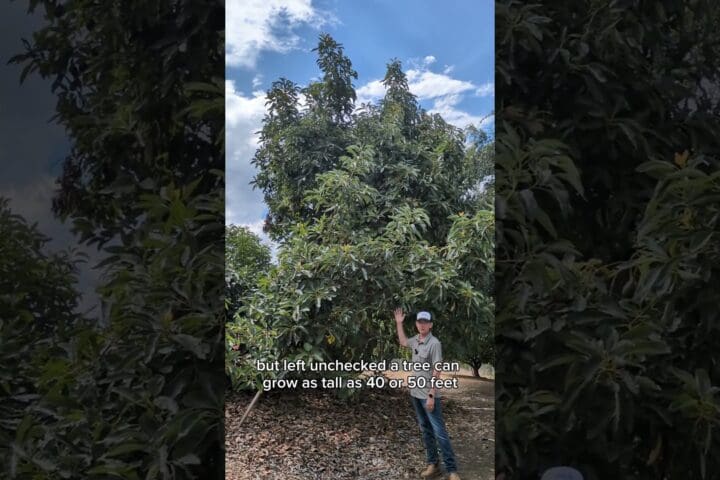
A heavy infestation leaves green leaves hanging in the tree covered in spots, and then littering the ground underneath it. An established tree tolerates low-level mite activity, but a bad year strips the canopy. One of our trees went from a full canopy to bare branches.
The defoliation is usually not what costs you the crop. Sunburn is. Once the leaves drop, bark and fruit are exposed, and the UC handbook notes that sunburn is worst on the south and southwest sides of the tree and that it usually follows leaf loss from root rot, persea mite or water stress. If a tree defoliates badly, whitewash the trunk and the big limbs. Fruit that loses its leaf cover does not ship.
What the handbook says to do alongside a release
Book Two treats persea mite as one of the two key avocado pests, alongside avocado thrips, and it is clear that there is no research-based threshold for spraying. Its cultural advice is the same list we have landed on ourselves, and it matters at least as much as the predators do:
- Remove weeds and other host plants nearby. Many common weeds host persea mite.
- Keep trees well watered and free of root stress. A stressed tree takes far more damage.
- Do not overfeed. Quick-release nitrogen raises mite numbers.
- Keep dust down. Road dust weakens the predators.
- Whitewash trunks and big limbs if leaf drop has left them exposed to the sun.
When to expect them
Numbers are lowest around March, build on the spring flush, and usually peak in July and August. Several days in a row above 100°F with low humidity can crash them on their own. That seasonality is why timing a release matters: starting when about half the leaves have mites generally means late spring and summer, not mid-winter.
Some varieties take it worse than others
In the UC cultivar comparison, Hass rates low for persea mite tolerance and Gwen very low, while Bacon and Lamb Hass rate high and Reed moderate. That is not a reason to pull a Hass out of the ground, but it does explain why the same mite pressure can look far worse on one tree than on the one next to it.
Two questions we keep getting
What are the beneficial insects you release?
Neoseiulus californicus, sold as Amblyseius californicus on some labels, in controlled-release sachets hung dry and in the shade inside the canopy.
Where do you buy them?
Arbico Organics. This is the exact product we ordered. That is what we actually bought and used, which is the only reason it is on this page. One thing to note when you order: supplier labels list the spider mites this predator is sold to control and do not always name persea mite specifically, so buy it understanding what the handbook says about effectiveness above.
Watching it happen in our grove
- From Full Canopy to Bare Branches: What Persea Mites Did to One Avocado Tree
- Finding Persea Mite Webbing and Ordering a Million Predatory Mites
- Polka-Dotted Avocado Leaves: Fighting Persea Mites With Predatory Mites
- Did Predatory Mites Work? Checking Our Avocado Leaves Weeks Later
- We Stopped Spraying Roundup, but the Weeds Still Had to Go: Weeds and Persea Mites
- How to Grow Avocado Trees: A Grower’s Complete Guide