Thin Skin, Thick Skin: What Avocado Skin Tells You About Fuerte and Hass
Hold a young Fuerte and a young Hass side by side and the first thing you notice is the skin. The Fuerte’s is thin and smooth. The Hass has thicker, rougher skin. It looks like a small detail, but that one difference goes a long way toward explaining the history of the California avocado industry — and why the grocery store sells almost nothing but Hass.
Fuerte: the old standard
Fuerte was the granddaddy of California avocados. Avocados were first planted in California from around 1850, but Fuerte itself came later. In 1911 a nursery collector brought budwood labeled “No. 15” back from a backyard tree in Atlixco, Mexico. When the January 1913 freeze killed most of the young trees in the nursery, No. 15 survived, and it was renamed Fuerte, the Spanish word for strong. The first Fuerte orchard went in near Yorba Linda, and for the first half of the twentieth century it was the variety the California industry was built on.
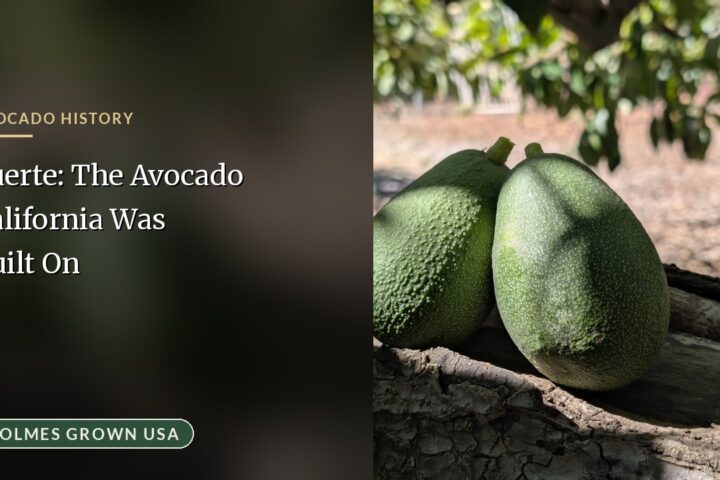
Here at the house, the trees went in during the 1960s and 70s, and they are still producing. Fuerte fruit is green, smooth and thin-skinned, with a flavor we love. But thin skin marks easily, and that turned out to matter a great deal.
Read nextWhy Fuerte Lost California to Hass: Alternate Bearing and a Mail Carrier’s Tree
Hass: the one that took over
Hass is what grew the avocado industry into what it is today. Over time, growers selected, planted and harvested Hass in ever greater numbers. Shipping was a big part of it: the thicker, pebbly skin protects the fruit on the long trip from grove to packing house to store. The skin helps in other ways too. It turns black as the fruit ripens, which tells shoppers when it is ready, and the dark color hides bruises and pickers’ fingernail marks. Add a longer harvest season than Fuerte, and the choice made itself.
It still took decades. Shoppers had learned that avocados were green, so black fruit was a hard sell at first. Hass was about 15% of California’s crop in 1957, passed Fuerte in volume in 1972, and by 1990 made up 83% of production against just 2% for Fuerte.
The tree started as a single seedling on Rudolph Hass’s grove in La Habra Heights, and its story is worth reading on its own: see Hass Avocado Patent 139.
Why is one skin thin and the other thick?
It comes down to ancestry. Avocados descend from three races: Mexican, Guatemalan and West Indian. According to the UC growers’ handbook, Mexican-race fruit have thin, delicate skins that tear easily in shipping and handling, while Guatemalan-race fruit tend toward thick, woody skins. Fuerte is roughly half Mexican and half Guatemalan. Hass is about 85% Guatemalan and 15% Mexican, so it got more of the tougher skin.
Early California growers actually argued over this, thin-skinned Mexican types against thick-skinned Guatemalan ones. The California Avocado Society’s variety committee eventually settled it by backing two hybrids with good qualities from both races: Fuerte and Hass.
Why does skin matter so much?
Because most avocados are not eaten where they grow. They are picked, packed, trucked, stored and handled many times before they reach a kitchen. A tougher skin means fewer bruises and less waste along the way, which is worth a lot to everyone in that chain. So pretty much whatever you get in the grocery store is a Hass.
The trade-off is choice. Thin-skinned varieties like Fuerte are still wonderful to eat; they just do not survive the supermarket system as well. We make that case in Hass vs Fuerte: why your grocery store only sells one, and there are plenty more varieties in our guide to avocado varieties.
Telling them apart
- Fuerte: thin, smooth, green skin that stays green as it ripens; a pear shape, often with a slightly flat spot near the bottom; usually 8 to 14 ounces.
- Hass: thicker, rougher, pebbly skin that darkens to black as it ripens; usually 6 to 14 ounces.
- On the tree: crush a Fuerte leaf and it smells of anise, a trait from its Mexican side.
Because we ship straight from the tree, we can send the thin-skinned one too. When Fuerte is in season, our 4lb Fuerte box ships free, alongside our Hass boxes; out of season, the waitlist on each page will let you know when fruit is back.
This post is part of our guide to the history of California avocados.