Are Farmers Rich? The Reality of Agricultural Income and California Family Farms
Most farmers are not rich: many own valuable land and equipment, but the farming itself often earns little or even loses money, and the household lives on other income. A common public perception suggests that owning farmland equates to vast personal wealth. Following our recent discussion regarding California’s Assembly Bill 1066 and its impact on family agriculture, a viewer left a candid remark: “Farmers are rich. Give us a break.” While it is easy to conflate valuable real estate or large equipment inventories with liquid wealth, the economic reality facing family growers tells an entirely different story.
To understand the actual financial landscape of modern agriculture, we must separate gross farm asset values from day-to-day operational margins.
The Economic Reality: USDA Net Farm Income Data
The United States Department of Agriculture (USDA) conducts extensive economic tracking through its Economic Research Service (ERS). Their data reveals an eye-opening metric that surprises many outside the agricultural industry: the average American farmer experiences an average net loss of roughly $1,800 per year from farm-related operations.
While agricultural operations generate substantial gross revenue, the expenses required to operate—fertilizer, irrigation water, fuel, specialized machinery, labor, pest mitigation, and compliance—frequently outpace the price received at harvest. For small to mid-sized family farms, operational profitability is often razor-thin or negative depending on seasonal market volatility.
Read nextWhy Is the American Farmer Disappearing? The Question Becca Asked After a Hard Week
The Necessity of Off-Farm Income
Given that direct agricultural production yields an average net deficit across many farm classifications, a natural question arises: how do family farms remain operational?
The answer lies in what economists classify as off-farm income. In most agricultural households across the country, positive net household income is derived from non-farm employment, secondary businesses, or agritourism ventures.
- Commercial Vineyards: A winery often derives its margins from retail bottle sales, event hosting, and tasting rooms, rather than the raw market value of growing bulk grapes.
- Off-Farm Employment: One or more family members typically maintain full-time corporate, trade, or professional careers to subsidize grove maintenance and secure health benefits.
- Direct-to-Consumer Programs: Packing and shipping farm-direct boxes allows family operations to capture a higher percentage of the retail food dollar.
The Market Dilemma: Farmers as Price-Takers
Unlike conventional consumer goods companies or service providers, agricultural producers rarely set their own prices. In wholesale agriculture, growers are price-takers rather than price-makers.
When we harvest avocados here in Southern California, the price per pound is determined by nationwide and global market indices. If an influx of imported fruit floods the domestic market during peak harvest, the wholesale price drops instantly. Even if our localized production costs—such as water rates, regulatory compliance, and state-mandated overtime wages under policies like AB 1066—rise dramatically, our payout per pound does not automatically adjust to compensate.
Why Avocado Income Swings So Much From Year to Year
Even a well-run grove does not produce a steady paycheck. Avocado trees, and Hass in particular, tend toward alternate bearing: a heavy crop one year cuts the number of flowering shoots the next spring, so a big year is often followed by a small one. Avocado Production in California: A Cultural Handbook for Growers, Book One, gives a striking example from one 10-acre Hass grove. Over five years it averaged a respectable 8,752 pounds per acre, but the individual years were 20,995, 4,057, 14,260, 1,813 and 2,635 pounds per acre. Imagine budgeting a household on income that can fall by more than 80% from one year to the next.
Weather adds to it. The handbook notes that damaging freezes come to California avocado country about every ten years. The December 1990 freeze destroyed at least 20% of the statewide crop, and losses were total in parts of Ventura and Santa Barbara counties. The January 1937 cold spell took a third of the crop. On the other end of the thermometer, temperatures over 105°F in late May or June have been known to drop almost the entire crop of young fruit. None of those losses reduce the water bill or the property tax.
A Grove Is a Long, Slow Investment
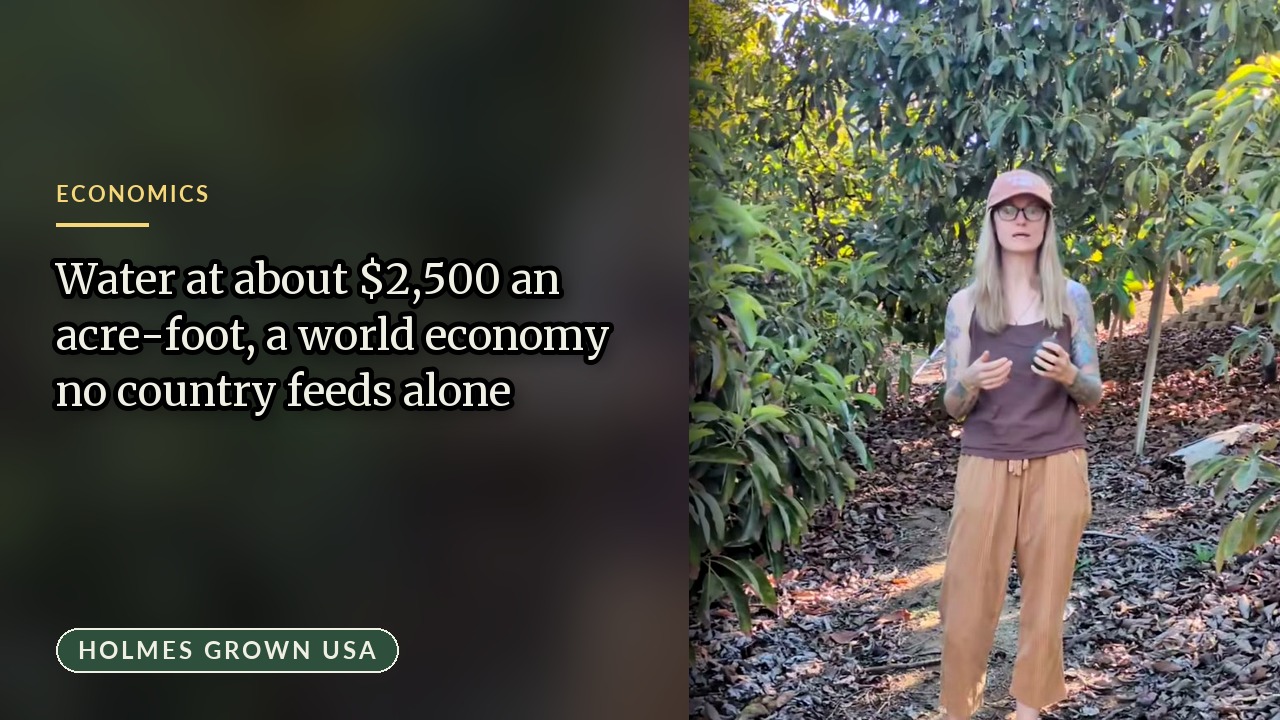
Planting avocados is a bet measured in decades. Grafted trees mostly start bearing in their third year after planting and do not reach full production until years eight to ten. Trees on root-rot-tolerant clonal rootstocks, which are often needed to replant old ground, cost about twice as much as standard seedling-rootstock trees. Then there is water: in 2012 growers in Fallbrook were paying $1,100 per acre-foot and those in the Valley Center Water District $1,300 to $1,400. The handbook’s companion volume on cultural care says most San Diego County groves need about 3 to 3.5 acre-feet of water per acre per year, so at those 2012 prices water alone ran roughly $3,300 to $4,900 an acre every year.
History shows how easily optimism outruns the numbers. Between 1976 and 1980 the California industry expanded to 80,000 acres and more than 8,000 growers, a “Gold Rush” that the handbook says eventually turned into a market glut and low prices. Even the man behind the most famous avocado in the world did not get rich from it. Rudolph Hass patented the Hass avocado in 1935, and by the time the patent expired in 1952 he had earned only about $4,800 from it.
We have put our own numbers on the table in what an avocado farm actually pays its owners and how we lost $30,203 on 52,000 pounds of Hass.
Why Understanding Farm Economics Matters
When consumers assume that independent growers are sitting on vast fortunes, the true cost of local food production becomes obscured. Maintaining domestic food security requires preserving the multi-generational family farms that cultivate high-value specialty crops.
Every time you choose domestically grown produce, seek out local farm boxes, or engage with agricultural educational content, you help ensure that independent growers can continue stewarding the land for the next generation.
We encourage you to explore our other grove updates and field notes to learn more about how Southern California avocados are grown, harvested, and brought to your table.
If the numbers above are sobering, buying direct is the part that actually helps. Our 4lb Hass box and 6lb Hass box ship free, picked the week they go out; between harvests the waitlist on either page will tell you when picking starts. Until the trees are picking again, the avocado scoop, the Hawaiian shirt and our hats ship year-round.
This is part of our complete guide to what it really costs to run a California avocado farm — the grower statement, farm gate pricing, and the numbers behind a family grove.