Commercial Avocado Grove Revitalization: Well Drilling, Power, and Replanting 10 Acres
Reviving a commercial avocado grove comes down to three things done in order: secure water, bring in power, and replant with trees set up to last. Taking on the rehabilitation of a legacy avocado orchard requires careful planning, significant financial commitment, and reliable infrastructure. We are officially beginning the process of restoring our family commercial avocado grove, an expansive 10-acre property situated roughly twenty minutes north of our main operation. This ground holds decades of heritage, having been established by my parents in 1974, but modern farming demands a modern approach.
Over the past several months, we completed the intensive planning and paperwork required for an agricultural development loan. With financing moving forward, we are preparing to launch a complete, multi-stage revitalization of the property. Here is an inside look at what goes into modernizing a historic commercial avocado grove in California.
Securing Water Infrastructure: The Agricultural Well
Water security remains the single most critical factor in commercial avocado production throughout Southern California. Mature avocado trees require consistent, high-volume irrigation throughout the heat of summer and early fall, and relying solely on municipal or district water rates can strain farm margins beyond sustainability.
The first major capital phase on the 10-acre property will be drilling a dedicated agricultural well. Sourcing ground water on-site provides several advantages:
- Long-term cost stability against escalating district water prices.
- Direct oversight of water quality and pressure across the irrigation blocks.
- The capacity to design micro-sprinkler systems tailored to the topography of the grove.
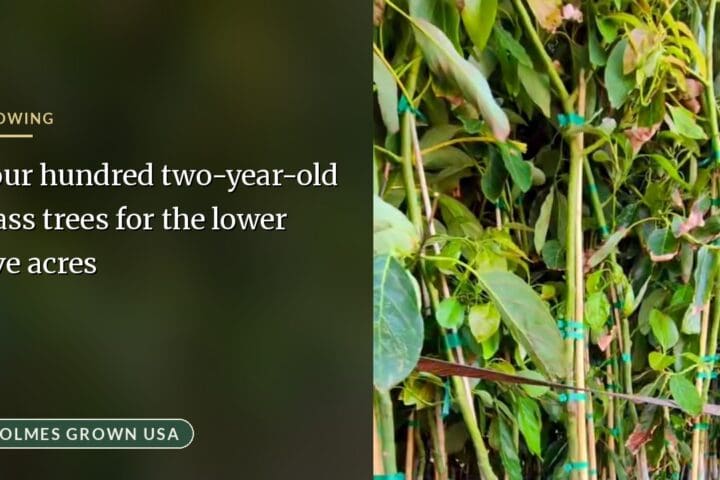
Read nextPlanting 400 Hass Avocado Trees: Expanding Our Commercial Mountain Grove
How Much Water Does a 10-Acre Avocado Grove Need From a Well?
Avocado Production in California: A Cultural Handbook for Growers, Book One, gives a useful rule of thumb: a mature acre of avocados needs at least 4,500 gallons a day in summer in most interior Southern California areas, even on drip, and a pump should not run more than 50 to 70 percent of the time. At 50 percent (12 hours a day), that works out to about 6.25 gallons per minute per acre, or roughly 62.5 gallons per minute for a 10-acre grove. That is the kind of yield any new well has to be measured against.
Book Two of the handbook, on cultural care, lands in the same range from a different direction. Its Escondido tables put peak July use at about 57 gallons per tree per day at 20-by-20-foot spacing, roughly 6,200 gallons per acre per day once a leaching allowance and uneven emitter output are included, and it recommends designing a system that can deliver that in no more than 16 to 18 hours a day. That works out to about 5.4 gallons per minute per acre if you water seven days a week for 18 hours, or a more realistic 8.4 gallons per minute per acre on five 16-hour days: roughly 54 to 84 gallons per minute for 10 acres.
Quantity is only half the question. Avocados are sensitive to salt, and the same handbook puts maximum yield at water with an electrical conductivity (EC) below about 0.9, roughly 576 ppm of dissolved salts, with around a 10 percent yield loss by EC 1.2 and a 50 percent loss by EC 2.4. Chloride does more harm than other salts, and on Mexican rootstocks well-water chloride should stay below 5 meq/L. Book Two is blunter: well water with an EC above 1.2 is usually not suitable for avocados, and chloride or sodium above 100 ppm, or boron above 1 ppm, calls for extra leaching. It also notes those yield-loss figures are theoretical; in a five-year Escondido trial, reclaimed water at EC 1.5 cut yields by 40 percent. A water-quality test has to come back before a single tree goes in. We walk through the hydrogeology and cost per foot in drilling an avocado farm well, and our guide to watering avocado trees covers what the trees do with that water.
Bringing Power to the Orchard
Once a well is drilled, driving water across undulating hillside acreage requires dependable electrical service. A major component of our agricultural loan entails running commercial power to the grove. Setting up proper electrical infrastructure allows us to power heavy-duty well pumps, run automated valve controllers, and install smart monitoring stations across the acreage.
Modern commercial avocado management depends on precise irrigation timing. Having dedicated power on-site guarantees that fertigation systems and automated timers run without reliance on temporary generators or remote workarounds.
Replanting a Legacy 10-Acre Grove
The trees my parents planted half a century ago carried our family through decades of harvest. However, commercial avocado trees experience declining yields as root systems age, canopies become overgrown, and root rot pressures accumulate over forty to fifty years. To ensure the grove remains productive for decades to come, revitalization requires a fresh start.
The replanting phase involves several distinct steps:
- Clearing aging, non-productive wood and chipping organic material to retain soil moisture.
- Testing and conditioning the hillside soil with organic amendments to optimize pH and nutrient availability.
- Selecting vigorous clonal rootstocks paired with high-yielding avocado varieties suited for modern commercial packing standards.
- Laying down durable irrigation lines designed for optimal root-zone coverage without runoff.
Replanting Where Old Trees Declined
Where old trees have declined from root rot, replanting the same ground is “not as simple as merely replanting with a tolerant rootstock,” as the handbook puts it. There is no true resistance to Phytophthora cinnamomi among rootstocks that graft to avocado, only degrees of tolerance, so the rootstock is one part of a package. The handbook’s recommendations for root-rot ground include:
- A tolerant clonal rootstock. Clonal trees cost about twice as much as trees on seedling rootstock, which the handbook calls a prudent investment.
- Planting on mounds so the root ball sits above native soil.
- A wood-based mulch 3 to 4 inches deep, kept away from the trunk. For established trees on root-rot ground, Book Two’s disease chapter asks for at least 4 to 6 inches of coarse organic mulch, and warns that mulched trees are easy to over-water.
- Gypsum at 10 to 20 pounds per tree (Book Two suggests about 25 pounds under a medium-size tree, topped up as it dissolves).
- Gopher control, because burrows channel water, and Phytophthora with it, through the grove, and drip and mini-sprinkler systems tend to favor gophers.
- A root-ball drench at planting with fosetyl-Al or buffered phosphorous acid, followed by two or three foliar sprays that first year.
- Young trees on their own irrigation block instead of the mature grove’s schedule.
Drainage matters as much as any of it. Avocados want free-draining soil at least three feet deep, and even without disease their roots begin to die after about 48 hours of flooding. Fumigating and replanting is not the shortcut it sounds like: P. cinnamomi re-invades fumigated soil, and root rot can come back worse because the competing soil microbes are gone.
Spacing and Timing for a Grove Replant
The traditional California spacing is 20 by 20 feet, or 109 trees per acre. Spacing of 15 by 20 feet (145 trees per acre) is also common, with every other tree meant to come out once the canopies crowd, although the handbook notes many growers never thinned and ended up with crowded groves fruiting only at the top. Spring is the best planting window: roots usually flush in May, so trees planted in March or April establish fastest. Holes should be dug about the same depth as the root ball, and the handbook is firm that no compost or other amendments go into the backfill, because amendments like manure have killed young roots with salt and ammonia. Our own replant will start as a straight replacement at the same density as the existing grove; once the new trees are in, we plan to increase the density. For the other side of the ledger, see the economics of our avocado farm.
Documenting the Journey from Ground Up
Restoring a commercial orchard is an enormous undertaking that highlights both the business realities and physical labor of independent farming in California. We intend to document every step of this revitalization process—from the day the drilling rig arrives on site to the final sapling planted in the dirt.
Stay connected with our ongoing updates as we share real-time progress, engineering decisions, and the day-to-day realities of family grove management.
The replanting is paid for by the fruit the older blocks still put out. Our 4lb Hass box and 6lb Hass box ship free, picked the week they go out; between harvests the waitlist on either page will tell you when picking starts. Until the trees are picking again, the avocado scoop, the Hawaiian shirt and our hats ship year-round.