Brown Tips on Avocado Leaves: Why It May Be Salt, Not Sunburn
Are the tips of your avocado leaves turning brown? It is easy to blame the sun, but it may not be sunburn at all. Very often, brown leaf tips on an avocado tree point to a salt imbalance.
Avocado trees are extremely sensitive to salt and simply do not like salty water. The usual fix is not less water but, counterintuitively, a little more: growers add what is called a leaching requirement to push salts down and away from the roots.
What salt damage looks like
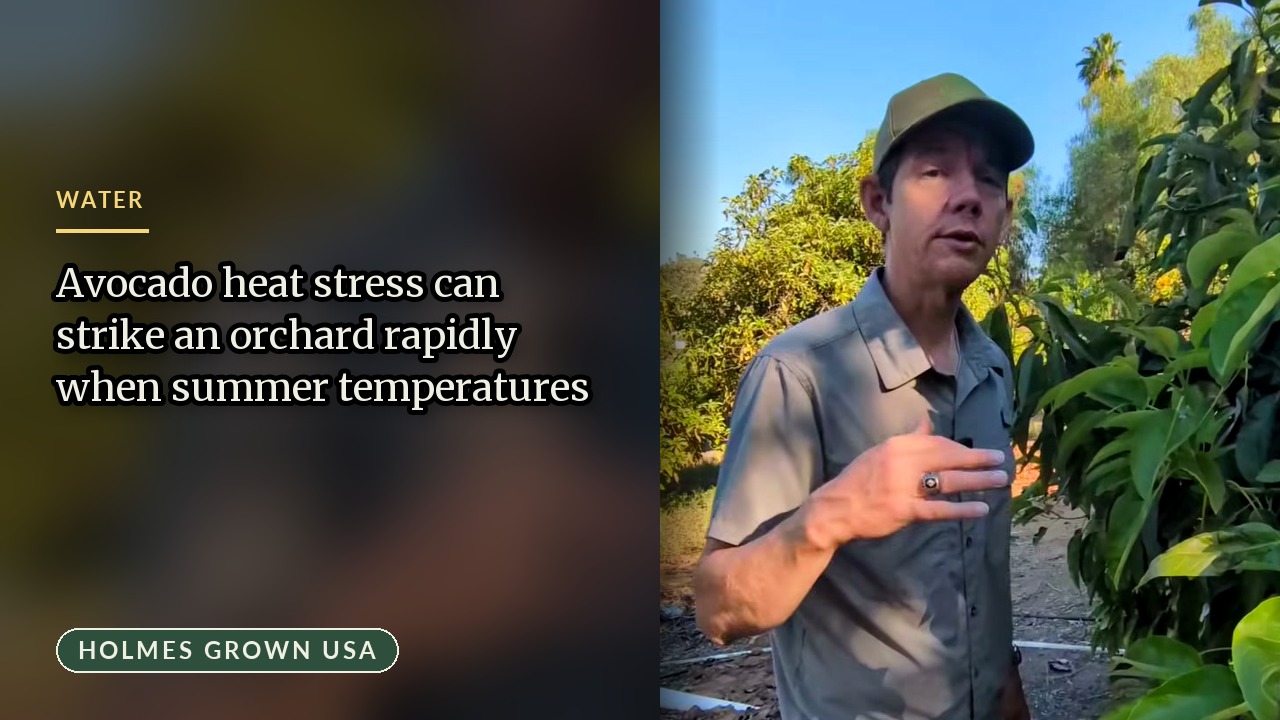
The tree in this video is doing really well overall. It is full, green and growing. But look closely at some of the leaves and the very tips are brown. That pattern, damage that starts at the tip and works back, is typical of salt, because the leaf tips are where salts carried up with the water tend to build up.
Chloride is usually the main culprit. It rides up with the water and builds up in the leaf tips over the season; once it passes about 0.25 percent of the leaf, the tip tissue starts to die, and the familiar tip-burn usually shows in September and October. The tree then drops those leaves, and the flush that replaces them comes in late winter and early spring, just when it should be flowering. Bloom is weak, and severe tip-burn can cut yields for at least two years, so salt costs crop as well as looks.
Sunburn looks different. It tends to show up on the south and southwest sides of the tree, on exposed fruit and bark, and it is tied to how much canopy cover the tree has. We cover that side of it in avocado sunburn and water sprouts. For a broader checklist of what leaves can tell you, see our guide to avocado leaf health.
Where does the salt come from?
Mostly from the water itself. Irrigation water carries naturally occurring salts. The tree takes up the water it needs, and the salts get left behind in the soil. Irrigate the same way season after season and they accumulate right where the feeder roots are.
Manure is another source: almost all manures carry a lot of salt, which is why the UC handbook says to age it through at least one winter of rain before spreading it. And tip-burn is not a nutrient deficiency, so more fertilizer will not fix it.
Rootstock plays a part too. Mexican-type rootstocks, which most California trees were grafted onto, are the least salt tolerant. If you are planting and your water is on the salty side, it is worth asking the nursery about more salt-tolerant clonal rootstocks such as Toro Canyon.
What is a leaching requirement?
It is extra water applied on purpose. A lot of growers add an extra 10 to 15 percent on top of what the tree actually needs each time they irrigate. That surplus moves down through the soil and carries the salts with it, pushing them past the root zone so the roots stay in cleaner soil and the tree stays healthy. The UC handbook calls leaching the only way to reduce salt in the root zone. It builds a 10 percent leaching fraction into every irrigation and says that is probably enough for district water; the standard leaching formula gives about 16 percent for district water at an EC of 0.9, and about 30 percent for the reclaimed water used in an Escondido trial.
It sounds wasteful in a place where water is expensive, and it does cost money. But the alternative is a tree slowly poisoning its own root zone. The leaching fraction is part of the real water bill for any avocado tree in California, which is why it belongs in any honest answer to how much water an avocado tree needs.
How much extra should you add?
The 10 to 15 percent range is a starting point, and the right amount depends on your water and soil. A water test helps: avocados do best with water under an EC of about 1.0 (roughly 640 ppm of dissolved salts), and yields fall off as it climbs. One classic estimate puts the loss at about 10 percent at an EC of 1.2, 25 percent at 1.7 and half at 2.4, and a five-year Escondido trial found real losses were worse: water at EC 1.5 cut yield 40 percent. Chloride or sodium above about 100 ppm in your water is a signal to take leaching seriously. A soil sample from inside the sprinkler’s wetted area in mid-summer, tested for salts, chloride and sodium, can warn you to run a long leaching irrigation before the tips burn. To make the math easier, we built a free avocado irrigation calculator. It adds in a leaching requirement that you can adjust, so you do not have to work it out by hand. You will find it in the tools section of holmesgrownusa.com.
This video is part of a series answering the irrigation questions we get most as avocado growers. If you are comparing a tree’s needs with the rest of your yard, avocado tree water use versus a lawn is a good next read.
Try this: If brown tips keep coming back, the fix is usually more water rather than less: enough to push the salts down past the root zone.
Healthy roots are what put good fruit on the tree. Our 4lb and 6lb Hass boxes ship free when we are picking, and the waitlist on either page will tell you when fruit is back.