Uphill Trees Getting Less Water? Test Each Sprinkler With a Pressure Gauge
If one of your avocado trees looks thirsty while the rest of the grove is fine, check where it sits. Some of our trees are uphill from the pump, and that alone can explain it: as water climbs, pressure drops, and as pressure drops, the sprinkler puts out less water — unless it has a pressure-compensating head.
The good news is you do not have to guess. A simple pressure gauge from a big box store will tell you exactly what each head is getting.
Why does going uphill steal pressure?
Water has weight. Every foot you lift it costs pressure — as a rule of thumb, roughly one pound per square inch for every 2.3 feet of climb. On a hillside grove, the difference between the lowest and highest tree can easily be tens of feet, and the pipe itself adds friction losses on top.
Hillside groves are normal around here. Avocado Production in California: A Cultural Handbook for Growers, Book One, notes that Southern California growers have planted avocados on steep slopes since the 1970s, and that low-volume irrigation is one of the things that made it possible. The catch is that low-volume systems are exactly the ones that are sensitive to pressure.
So a line that delivers healthy pressure at the bottom of the slope may be delivering much less at the top. The trees down low get their full drink. The trees up high get a fraction of it, run after run, and nobody notices until the tree starts to struggle.
Read nextAvocado Tree Irrigation: How to Adjust Sprinklers as Trees Grow
Less pressure means less water
A standard sprinkler or micro-sprinkler is sized to deliver a certain flow at a certain pressure. Drop the pressure and the flow drops with it. Your controller says every tree got the same number of hours; in reality, the uphill tree got noticeably less water in that time.
That is why a single watering schedule can leave part of a hillside grove chronically short, and why working out how long to water with our irrigation calculator only works if you know what your heads are actually putting out.
How to test your pressure
Pick up a pressure gauge that fits your sprinkler risers or a test fitting on your line. Then, with the system running, check the pressure at each irrigation head, working from the lowest tree to the highest. Write the numbers down.
- If pressure is fairly even from bottom to top, elevation probably is not your problem.
- If it falls off noticeably as you go uphill, your upper trees are being underwatered.
- Knowing the actual numbers lets you pick hardware rated for the pressure you really have.
Pressure is half the picture; output is the other half. The uniformity check in Avocado Production in California: A Cultural Handbook for Growers, Book Two, is to catch the water from at least 12 emitters spread evenly across a block for the same length of time, then divide the average of the lowest quarter by the overall average. Around 80 percent or better is attainable; below 80 percent, something needs fixing. A quick field check: a 35 mm film can that fills in 30 seconds means a 1-gallon-per-hour emitter. The handbook is clear that the major culprit of low uniformity is usually poor maintenance — clogged emitters and dirty filters — so flush the lines and clean the filter when the pressure drop across it reaches about 5 psi.
The fix: pressure-compensating heads
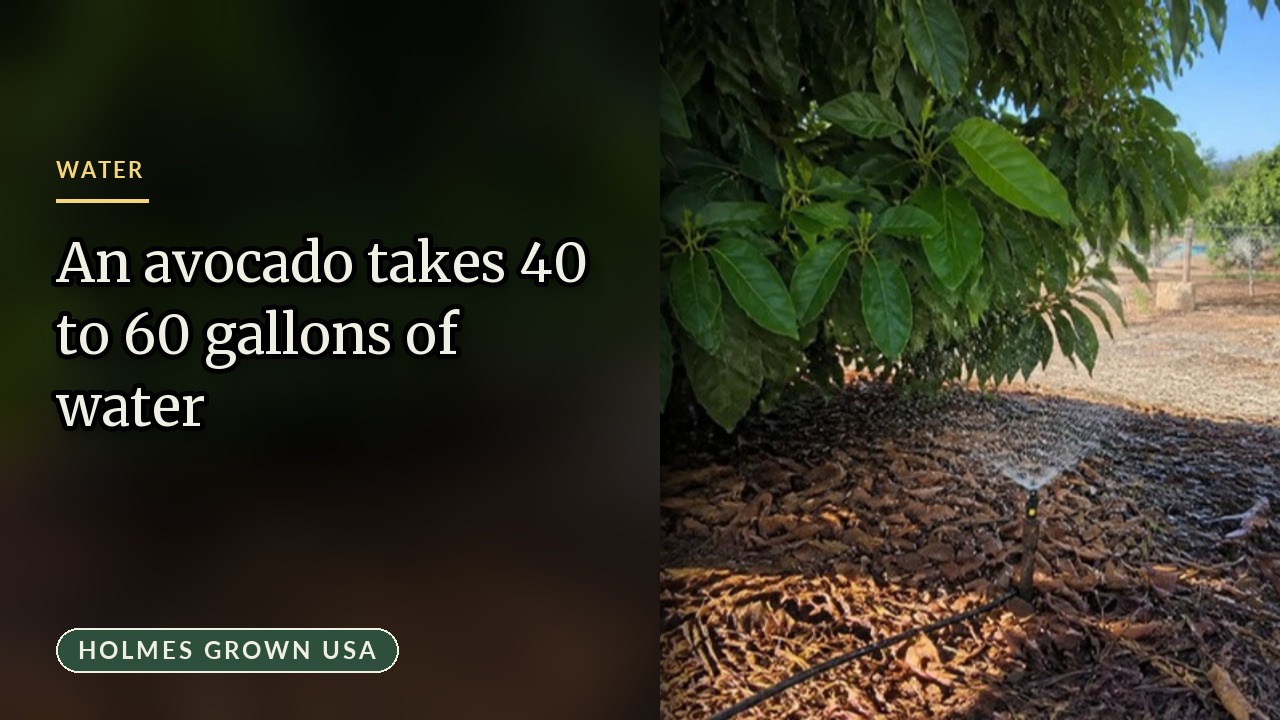
A pressure-compensating sprinkler head regulates its own output, so it delivers close to the same flow across a range of line pressures. Put them on a slope and the tree at the top gets roughly what the tree at the bottom gets. Each one has a minimum pressure it needs to work, which is another reason to measure first.
The handbook backs this up for hillside groves. It recommends pressure regulators preset at 20 to 30 psi, ideally one on each lateral line where it leaves the sub-main, and calls that especially important on hillsides. Without good regulation, a grower ends up over-watering most of the trees just so the driest ones get enough, which the handbook names as one of the main causes of wasted water in California groves. In one Escondido trial, pressure-compensating emitters held 92 percent uniformity for two years; when their silicone discs wore out, replacing them at about ten cents each brought the block back to 92 percent.
What pressure-compensating heads did for our grove
Our commercial grove sits on a very big hill, so we ran the uniformity test there. The gap between the worst and best spots was not pleasant: about 65 percent across the 10 acres. After we installed pressure-compensating heads, we measured about 95 percent. By the handbook’s yardstick, where 100 percent is impossible, 80 percent is attainable and 95 percent is not unheard of, we went from well short to about as good as it gets.
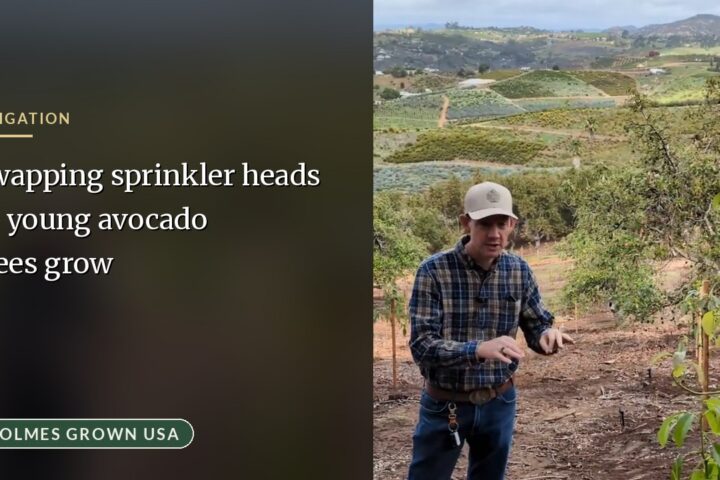
The video shows why the numbers were so far apart. Where the line runs downhill, gravity adds pressure, so the heads near the bottom run hard and put out more water. Where it pushes uphill, pressure falls twice over: each sprinkler takes its share before the water reaches the next one, and the climb itself costs pressure. A pressure-compensating head works like a small regulator built into each sprinkler, so within its working range the tree at the top and the tree at the bottom get the same water from the same run time.
Why even watering lowered our water bill
With poor uniformity, you have to set the run time for the tree getting the least water, or that tree goes thirsty. Every other tree then gets more than it needs, and you pay for all of it. Once every head puts out the same amount, you can water for the average tree instead of the worst one, and the extra you used to pour on the bottom of the hill stops showing up on the bill. When water is the biggest cost on a grove, as it has become for us and for growers across the region (see the water crisis behind disappearing groves), that difference matters. The same idea applies in a backyard with any real slope, or a long line with many heads on it.
How often should uphill avocado trees be watered?
Usually a little more often than the trees below them, in shorter sets. Hillside soils around Escondido tend to be coarse decomposed granite, which drains fast and holds little water. The handbook’s rule of thumb is to irrigate when 30 to 50 percent of the plant-available water is gone, and to use the 30 percent end of that range on coarse hillside soils.
For shallow hillside soils it suggests a pair of tensiometers: an 8-inch one that tells you to turn the water on at about 20 to 25 centibars, beside a 2-foot one that tells you to turn it off once it reads below 10. If the deep one never comes down on your uphill trees while the ones below are fine, that is your pressure problem showing up in the soil.
Do not let the top of the hill go short for long. The handbook warns that missing a series of irrigations for one to two weeks can start fruit drop and ruin that year’s crop. It also lists bacterial canker as a problem that shows up at the end of irrigation lines and where pressure is lowest, which is one more reason to keep the uphill trees evenly watered.
If you are planning a new zone on a slope, our irrigation zone designer helps with pipe sizing and how many trees a valve can carry. For the bigger picture on watering, see our complete guide to how much water an avocado tree needs.
Every tree on the hill matters to us, because every one of them fills boxes. Our 4lb and 6lb Hass boxes ship free, picked the week they go out — and when we are between harvests, the waitlist on either page will tell you when fruit is back.