California vs Imported Avocados: What’s the Difference?
Pick up an avocado in almost any American grocery store and there is a good chance it was grown in another country. Most avocados sold in the United States are imported. California is the main source of USA-grown avocados, and it is where our family has grown them since 1974.
So what is actually different between a California avocado and an imported one? Less than you might think about the fruit itself, and more than you might think about everything that happens to it before it reaches your kitchen.
Same avocado, different journey
Here is the part that surprises people: most imported avocados are the same variety as California ones. Hass dominates California groves and the import market alike, so a California Hass and an imported Hass start out genetically identical. The differences come from when the fruit was picked, how far it traveled, and how long it spent in the supply chain.
The typical path of an imported avocado
Avocados do not ripen on the tree; they only start softening once they are picked. That makes them well suited to long supply chains, and the typical grocery store avocado uses every bit of that. After harvest it goes to a packinghouse, travels hundreds or thousands of miles to reach the US, moves through one or more distribution centers, and is often held in cold storage along the way. Many large retailers also run fruit through ripening rooms, where controlled temperature and ethylene bring it to a predictable stage before it hits the shelf.
None of that is unsafe. But every step adds days, and by the time you buy it, you have no way of knowing how far into its life that avocado already is. That is why the same bag can hold one rock-hard avocado and one that is brown inside.
The path of a farm-direct California avocado
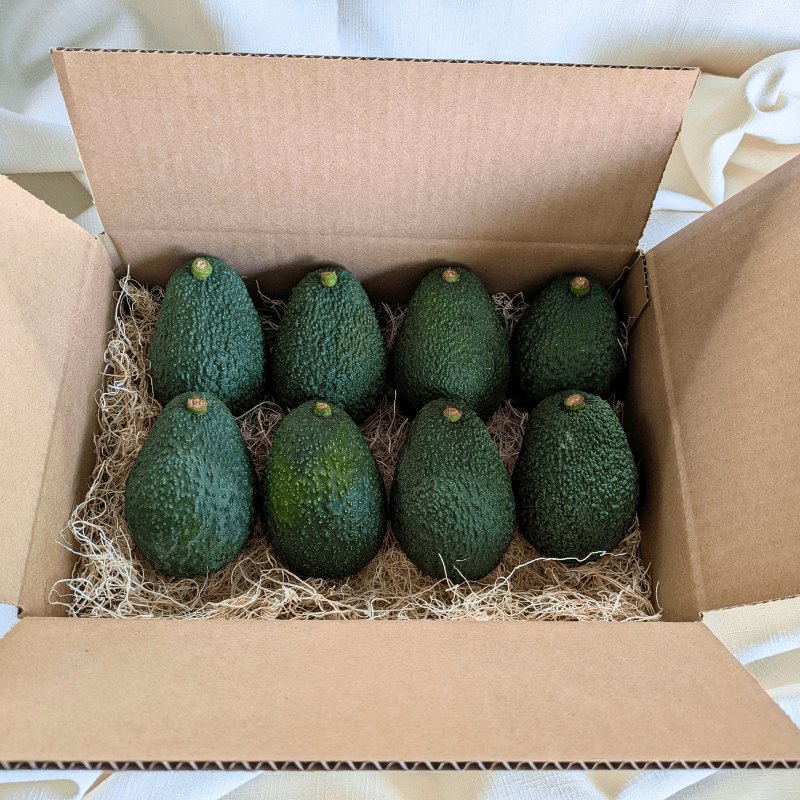
Ours is short, and it is the same every week. Orders in by Saturday are picked on Sunday or Monday, packed, and handed to the carrier on Monday or Tuesday. Two to five days later the box is on your porch, firm and roughly a week off the tree, with its whole ripening window still ahead of it. We wrote more about how long shipped avocados last once they arrive.
When each is in season
Seasonality is the biggest practical difference. Imports arrive year-round from several countries, which is why stores never run out. Chilean Hass, for example, has filled the fall and winter months since the mid-1980s. California avocados are seasonal.
| Source | Main season | What that means for you |
|---|---|---|
| California Hass | Spring through summer | The peak window for USA-grown Hass, and when late-season fruit carries the most natural oil. |
| California Fuerte | Late autumn and winter | A green-skinned heritage variety that fills the gap after Hass. We start picking ours in November. |
| Imported | Year-round | Sourced from several countries so stores are never without avocados, which is why imports fill most grocery shelves. |
If you want USA-grown avocados, the simplest rule is to buy California in season. Out of season, most of what you find in stores will be imported.
Do California and imported avocados taste different?
Honestly, the country matters less than the timing. Two things drive how an avocado tastes:
- How mature it was when picked. An avocado builds oil the longer it hangs on the tree. Fruit picked later in its season is richer, creamier and nuttier; fruit picked early can taste watery or flat.
- How long since it was picked. An avocado that spent weeks in storage and distribution has used up part of its life before you ever see it, and it is more likely to ripen unevenly or show dark streaks inside.
A well-grown, well-timed avocado from anywhere can be excellent. The advantage of buying California fruit in season, and especially buying direct from a grove, is that you know both answers: it was picked at the right time, and it was picked last week.
Different rules, depending on where it was grown
Imported avocados are inspected before they enter the country, and they are safe to eat. That inspection has a long history: from 1914 until 1997 a USDA quarantine kept Mexican avocados out of the US entirely, to keep out seed weevils and stem borers, and they were first let back in under strict pest-free-zone rules. They are, however, grown under a different set of rules. California growers work under some of the strictest agricultural regulation in the world, covering what can be applied to a crop and when (every agricultural pesticide use in California has to be reported), how water is used, and how farm labor is treated and paid. That regulation is a big part of why California fruit costs more to grow. We wrote about the grower’s side of this, and what it does to the price on the shelf, in imported avocados and California growers.
How to tell where your avocado was grown
In the US, fresh produce has to carry country-of-origin information at the point of sale. It takes about three seconds to check:
- The sticker. Many stickers print where the fruit was grown, such as “California” or the name of the exporting country. (The four-digit PLU number identifies the size and type, not the origin.)
- The bag or box. Bagged avocados list the country on the label.
- The bin sign. Loose fruit should have its origin on the display sign. If it is missing, ask the produce staff.
- Buy direct. When you order from a grove, there is no question at all.
Why buy USA-grown avocados?
- Fresher fruit. Shorter trips mean more of the avocado’s life is left for your kitchen.
- You know what you are getting. Where it was grown, under which rules, and when it was picked.
- You keep family farms farming. California has lost a large share of its avocado growers over the past few decades. Here is why only about 1,700 commercial avocado farms remain, and why water costs are a big part of it.
- More of your money reaches the grower. Buying direct cuts out the middle of the supply chain.
California vs imported avocados FAQ
Are imported avocados safe to eat?
Yes. Imported avocados are inspected before entering the US. The differences are in the rules they are grown under, how far they travel and how long they spend in the supply chain, not in whether they are safe.
Are California avocados better?
In season and bought fresh, many people find them noticeably better, mostly because of harvest timing and freshness rather than the soil they grew in. An in-season California avocado picked last week is hard to beat.
When are California avocados in season?
California Hass is at its best from spring through summer. Heritage Fuerte follows in late autumn and winter. Out of those windows, most avocados in stores are imported.
Are all Hass avocados the same?
Genetically, yes; every Hass tree descends from a single tree in California, a chance seedling Rudolph Hass bought in 1926 and planted in La Habra Heights, patented in 1935. Every Hass since has been grafted from that tree’s wood, which is why a seed from a Hass will not grow another Hass. In practice, how and when the fruit was picked and handled makes a big difference to the eating. There are also many other avocados worth trying; see our guide to avocado varieties and how they taste.
Taste a California avocado, straight from the grove
We are a second-generation family grove in Escondido, in North San Diego County. We pick to order, pack it ourselves and ship it direct, so your avocados are about a week off the tree when they arrive. See what is in season, or join the Fuerte list for November.
This is part of our complete guide to what it really costs to run a California avocado farm — the grower statement, farm gate pricing and the numbers behind a family grove.