Storm Aftermath in the Grove: Erosion, Fallen Fruit, and Soil Recovery
We just took over two inches of rain here in Escondido. After a storm like that, an avocado grove needs three things checked fast: whether water pooled around the trees, where roads and slopes lost soil, and how much fruit came down.
On a ten-acre grove built across steep ground, that much water in a short window is the kind of event that tells you exactly how well your drainage actually works. For context, the UC growers’ handbook puts average rainfall in Southern California avocado country at only 11 to 15 inches a year, so two inches in one go is a big share of a season.
So we walked the whole property the morning after, top to bottom, to see what held and what did not.
The Upper Grove: Drainage Doing Its Job
We started uphill, where our drainage ditches and swales take the first load. This is the part of grove management nobody films, because when it works correctly the result is that nothing happened. The water moved where we wanted it to move and kept going.
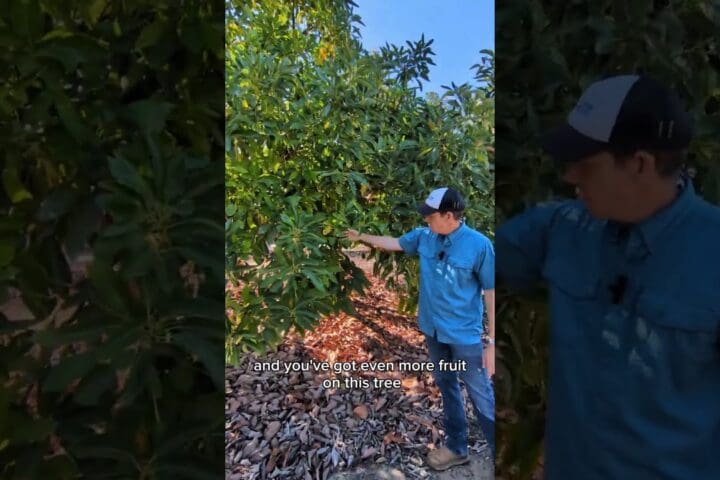
We did find casualties. Wind knocked down a fair amount of perfectly good fruit. Wind is a known cause of both leaf drop and fruit drop in avocados, and on exposed slopes the strongest winds can strip most of a crop. That is a real loss on the statement, but it is not a loss in the kitchen, and a batch of storm-fallen Hass makes excellent guacamole and avocado toast. (Fruit off the ground stays in our kitchen; we explained why in why ground-dropped fruit can’t be sold.)
The Lower Five Acres: Where the Damage Was
Downhill is a different story. The lower five acres took visible erosion across the access roads, which is what happens when runoff has slope and nothing to slow it down. Repairing those roads may mean bringing in excavators rather than fixing it by hand.
Running through that section is a gully roughly ten feet deep. Every heavy storm makes it a little more of a feature of the property and a little less of a drainage detail, and it is on the list of things we have to address deliberately rather than patch.
How Do You Stop Erosion on Avocado Grove Roads?
Most hillside grove erosion starts on the roads, not under the trees. The handbook’s road chapter, written with the USDA Natural Resources Conservation Service, boils it down to getting water off the road surface before it builds speed:
- Shape the road for its grade. On grades under about 8%, slope the road surface 2% to the outside so water sheets off onto a vegetated bank. Steeper than that, slope it 2% to the inside, into a ditch that feeds culverts with rock to break the flow.
- Put in water bars before the rains. These are low diagonal berms, at least 6 inches high and 6 feet wide, angled 30 to 45 degrees downhill and open at the low end. The steeper the road, the closer together they go: about every 125 feet at a 5% grade, 78 feet at 10%, and 47 feet at 20%. The handbook says to have them in by mid-November.
- Culverts at every natural drainage. Set at right angles to the road and sized to the watershed above them.
- Keep off wet roads. Driving on saturated roads only deepens the ruts; coarse soils usually dry out within a day or two.
What to Do After the Storm Passes
The handbook’s maintenance advice lines up closely with what we are doing this week:
- Inspect and clear culverts after the first rains that produce surface flow.
- Remove small blockages in road ditches by hand and leave the stabilizing vegetation in place.
- Save regrading of deep ruts for spring, when soil moisture allows good compaction. Grading wet ground just sets up the next washout.
- Abandon or relocate road sections that keep failing. Some ground is cheaper to route around than to repair every winter.
- Reseed bare cut and fill banks. The handbook suggests annual ryegrass under straw mulch (straw, not hay), with growth established by mid-October ahead of the next wet season.
Can Heavy Rain Hurt Avocado Trees?
Yes, if the water has nowhere to go. Avocado roots begin to die from lack of oxygen after about 48 hours of flooding, even without disease, and Phytophthora root rot is much worse in poorly drained soils. That is why the handbook wants soil that drains freely at least three feet deep, and why its simple site test is to dig an 18-inch hole, fill it with water, and walk away from any spot where water is still standing the next day. After a big storm, look for low spots where water sits around trunks and fix the drainage before the next rain.
Looking After the Trees Once the Rain Stops
The handbook’s second volume, on cultural care, adds a few points for the days after a big storm:
- Hold the irrigation. Do not water soil that is already wet. As little as three days of saturated soil can set roots up for Phytophthora root rot, so let the root zone start to dry before the system comes back on.
- Hold the fertilizer too. Waterlogged soil loses nitrogen as gas, so the handbook advises against fertilizing after a long rain has saturated the ground.
- Watch where you walk and drive. Phytophthora spreads easily on boots and tires through wet soil. Stay out of any root-rot patches until the surface dries, and work healthy areas before sick ones.
- Check the banks for burrows. Rain channelling down ground squirrel burrows is a known cause of collapsing road cuts, sometimes taking trees with them, and gopher burrows can carry root rot along in moving water.
- Clear fallen fruit and wait to harvest. Soil splashed up by heavy rain causes Phytophthora fruit rot on low-hanging fruit, and picking during or soon after rain invites stem-end rot. Let the trees dry first.
There is an upside: rain beyond what the trees can use still does useful work by leaching accumulated salts out of the root zone.
Leaf Litter Is Not Mess, It Is Infrastructure
The most useful erosion control on our grove is free, and it falls out of the trees.
Avocado duff, the layer of shed leaf litter on the grove floor, does two jobs at once. It locks moisture into the soil so we irrigate less, and it slows water at the surface so topsoil stays where it belongs instead of washing to the bottom of the hill. Anywhere the duff layer is thin, the erosion shows up first.
This is why we do not clear the grove floor. A tidy orchard is an orchard losing soil. The conservation practices in the handbook point the same way: organic mulch 2 to 4 inches deep, left on the surface rather than worked in, and ground cover of at least 60% through the rainy season on erodible ground.
What Comes Next on This Ground
Storm damage is discouraging in the moment, but this land is mid-revitalization and the plan does not change because of one wet week. We are working toward new plantings, efficient drip irrigation, and introducing additional avocado varieties into the orchard.
Some of the old trees will stay exactly where they are and serve as water breaks, slowing runoff on the steeper sections while the new plantings establish. Using what is already on the land is usually cheaper and more durable than engineering around it.
Bringing this piece of ground back to full production is a long project. Days like this one are just part of the cost of doing it properly.
This is part of our complete guide to growing avocado trees — time to fruit, height, roots, leaf health, pruning and picking, all in one place.