Are Dwarf Avocado Trees Real? Little Cado, Holiday and the Pruning Option
Yes, true dwarf avocado trees exist — but they are not what most people picture, and you probably do not need one. There are a few genetically dwarf varieties, such as the Little Cado and the Holiday, that you have likely never heard of. Most of the small avocado trees you see, though, are not dwarfs at all. They are just young.
And if what you really want is a tree short enough to pick every avocado by hand, you can get that from almost any variety with pruning.
What makes a tree genetically dwarf?
A genetic dwarf is a variety that simply grows smaller than others of its kind, however long you leave it. We have one in the backyard, though it is not an avocado: a dwarf mandarin. There are mandarin trees that grow much bigger, but this one is built to stay small, and it does.
Avocados have small varieties too. The Little Cado (one trade name for the Wurtz, which is also sold as Littlecado, Minicado or simply “Dwarf”) and the Holiday are the two we mention in the video. The University of California’s growers’ handbook describes Wurtz as a small tree ideal for gardens, and Holiday as a semi-dwarf that stays even smaller than Wurtz, with big green fruit of 18 to 24 ounces ready around December and January. They are far less common than the standard varieties, which is why most people have never come across them.
One caution if you live somewhere cold: Wurtz is a Guatemalan-type avocado and the least cold-hardy of the backyard varieties in the handbook’s list, rated to about 31°F, so it suits mild spots best.
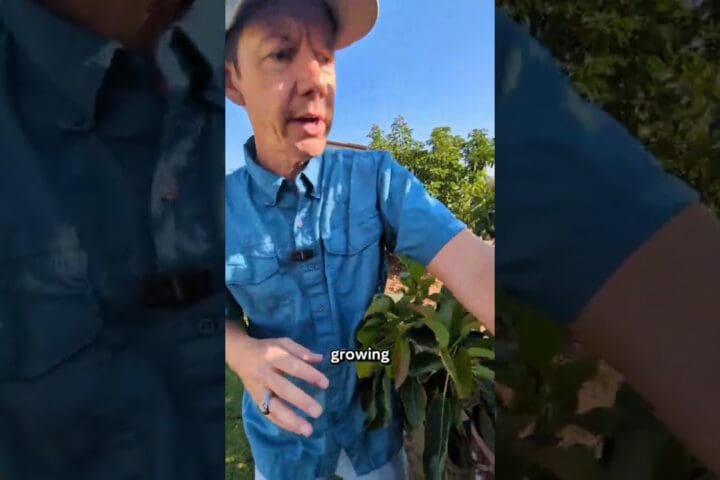
Our Reed looks like a dwarf. It is not.
The tree behind us in the video is our Reed. At a glance you might take it for a dwarf, but genetically it is a standard Reed. It is simply young — somewhere between six and eight years old. We honestly are not sure exactly how old she is.
This is the most common mix-up we see. A tree in a nursery pot, or a few years into the ground, is small because it has not had time to grow. Give a standard avocado enough years and it keeps going; left unpruned, a Hass can reach 50 to 60 feet. We covered just how far in how tall avocado trees grow.
Why we let most of ours grow big
Compare that Reed with the older trees around it and the difference is obvious. Those are monsters. On our property we let most of our avocado trees grow very large, and we will be honest about the trade-off: we sometimes miss out on the large fruit right at the very top. A pole picker gets us a long way up the canopy, but not always all the way.
How to keep any avocado tree small
When people ask about dwarf avocados, what they usually mean is: can I have a smaller, shorter tree so I can reach all my fruit? You can, even without a dwarf variety. Prune the tree to keep it to a smaller, more compact shape.
Reed happens to be a good example. It grows upright rather than spreading, and the handbook notes that some commercial growers plant Reed as close as 8 to 10 feet apart and keep the trees pruned to 10 to 12 feet tall while still getting excellent yields per acre. Spreading varieties like Hass are harder to keep compact, so expect to prune more often.
Timing matters too. The handbook’s advice is to prune in spring and not after the summer flush. In a UC trial, trees pruned in October lost most of the wood that would have fruited the next year. In the same trial, stumped trees trained to a central leader and topped at 14 feet could be picked entirely from the ground with picking poles.
That opens up your choice of variety. Instead of hunting for one of the rare dwarfs, you can plant the avocado you actually want to eat and manage its size yourself. Our guide to avocado varieties covers how Hass, Fuerte, Reed and Bacon taste if you are still deciding.
Pruning does ask for some care. Opening up the canopy too far can expose limbs and fruit to the sun, and the handbook recommends painting limbs left bare by heavy pruning with white water-based paint. So if you are shaping a tree for the first time, read up on avocado sunburn and water sprouts before you cut.
Got another question?
Leave it in the comments on the video and we may answer it in a future one. And if your own tree is still a few years from fruit, our 4lb and 6lb Hass boxes ship free while we are picking, with a waitlist on each page for the months in between. Until the trees are picking again, the avocado scoop, the Hawaiian shirt and our hats ship year-round.
This post is part of our guide to growing avocado trees.