Regenerative Avocado Farming: Why We Chose No-Till and Mulch on Our 10-Acre Grove
We chose no-till planting and on-site wood-chip mulch for our replant because both keep the soil on our hillside covered, cool and in place. Instead of trenching rows, we dug an individual hole for each young tree, and the old trees we took out went through a chipper and back onto the ground they grew in.
Regenerative avocado farming is shaping the way we manage our hillside orchard here in San Diego County. When we committed to planting 400 Hass trees across half of our 10-acre commercial grove, we knew we wanted to move toward organic, biological soil stewardship rather than repeat the conventional habits of decades past.
Back in the 1970s when Kirk’s parents farmed this land, bare soil, heavy mechanical work and synthetic inputs were standard procedure. Times were different, and conventional practices were what growers knew. As second-generation growers stepping in to rebuild the orchard, we have chosen a path built around soil health, erosion prevention and moisture retention.
Read nextRegenerative Avocado Farming: How to Protect Soil Health When Planting Trees
Why didn’t we till or trench the hillside?
Because the soil we already had was worth more left alone. A common way to plant a big block is to clear it, bulldoze it and cut long, continuous trenches down the slope for irrigation lines and young trees. Trenching is faster with heavy machinery, but it breaks up existing soil structure and the fungal life in it, and on a slope it opens a path for water to run.
Instead, we dug individual holes for every tree, about the same depth as the root ball. By opening only small planting sites, we left the soil between them undisturbed, so each young root system starts in ground that is already alive. Avocado Production in California: A Cultural Handbook for Growers, Book One makes a similar point about site work on slopes: hand clearing reduces the need to reseed bare ground afterward, and a good operator leaves the topsoil and its seed base in place.
What does chipping the old trees on site do?
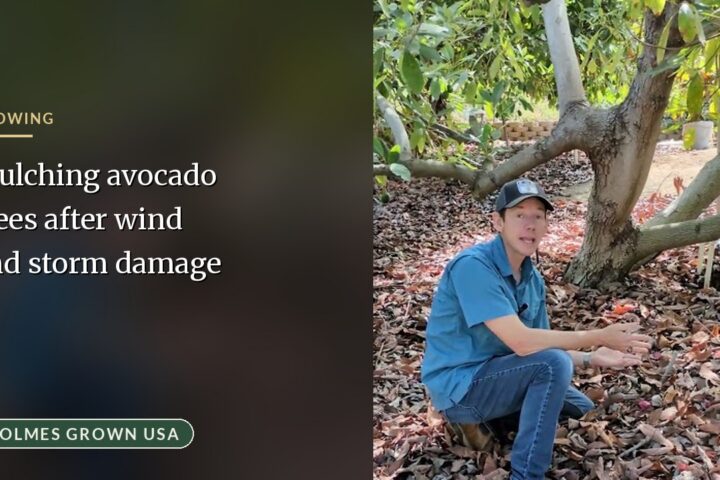
Many growers push brush into burn piles or haul woody debris away when they remove old trees and stumps. We chose to keep that organic matter where it grew. Every stump, limb and branch from the trees we cleared was run through a commercial chipper on site and spread across the orchard floor. That layer of coarse wood chips does three jobs:
- Nutrient cycling: as the chipped wood breaks down, it feeds fungal networks and returns organic matter to the topsoil.
- Moisture retention: a thick layer of chips shades the shallow feeder roots from summer heat and slows evaporation.
- Weed control: it holds weeds back without systemic herbicides.
The handbook backs this up. Avocado Production in California: A Cultural Handbook for Growers, Book Two recommends at least 4 to 6 inches of coarse organic mulch, kept several inches away from the trunk, and says ground wood does a better job than natural leaf drop. In soils infested with root rot, mulch gave growth increases of up to 43 percent. Chipping also beats leaving brush piles for another reason: the branch and twig borer breeds in stressed and dying wood, and prompt brush-pile disposal is part of the handbook’s prevention.
Mulch is not free of trade-offs. High-carbon wood chips can tie up nitrogen as they break down, and the handbook suggests giving young trees under straw or wood-chip mulch a little extra nitrogen. Mulched trees are also easy to over-water, because the chips cut evaporation, so soil moisture readings matter more under mulch, not less. We wrote more about rebuilding that layer in why mulch saves avocado trees.
How do we keep a steep hillside from washing out?
Anyone who has farmed avocados in North San Diego County knows that hillsides are a constant challenge. Our grove sits on a steep slope, and when winter storms hit Southern California, runoff and topsoil loss are a real risk.
Rather than scraping the ground bare, we let living ground cover hold the soil between the rows, with the wood chips covering the ground around the trees. Book One describes the same approach for erosion control: cover crops between rows on the contour, at least 60 percent ground cover during the rainy season, mowed to keep the height down and kept away from the sprinklers, until the tree canopy shades them out. Ground cover helps in three ways:
- Its roots bind the soil together.
- Its leaves break the force of heavy raindrops before they hit bare earth.
- It slows water moving down the slope, so more of it soaks in instead of carrying topsoil into gullies.
Under the trees themselves we keep weeds down. Weeds harbour persea mites and other pests, and Book Two notes that dense grass, cover crops and grass left against trunks are prime habitat for voles, so the basins stay under chips.
Building a resilient multi-generational orchard
Moving our commercial grove to regenerative practices is an ongoing commitment. From chickens foraging through the understory to monitoring soil moisture profiles, every management decision is aimed at building ground that will support these trees for decades to come.
If you want to dig deeper into practical hillside orchard care and irrigation setup, explore our hands-on guides in our grove field notes.
This post is part of our guide to growing avocado trees.