Sunburned Avocados: Why Fruit Without Leaf Cover Never Ships
Fruit hanging on a branch that put out no new leaves has nothing shading it, so it gets sunburned, and a sunburned avocado does not make the grade that packing houses ship. Not every avocado on our trees ends up in a box or a grocery store. There is no SPF for avocados. The tree’s own leaves are the sunscreen, and fruit that hangs without them pays for it.
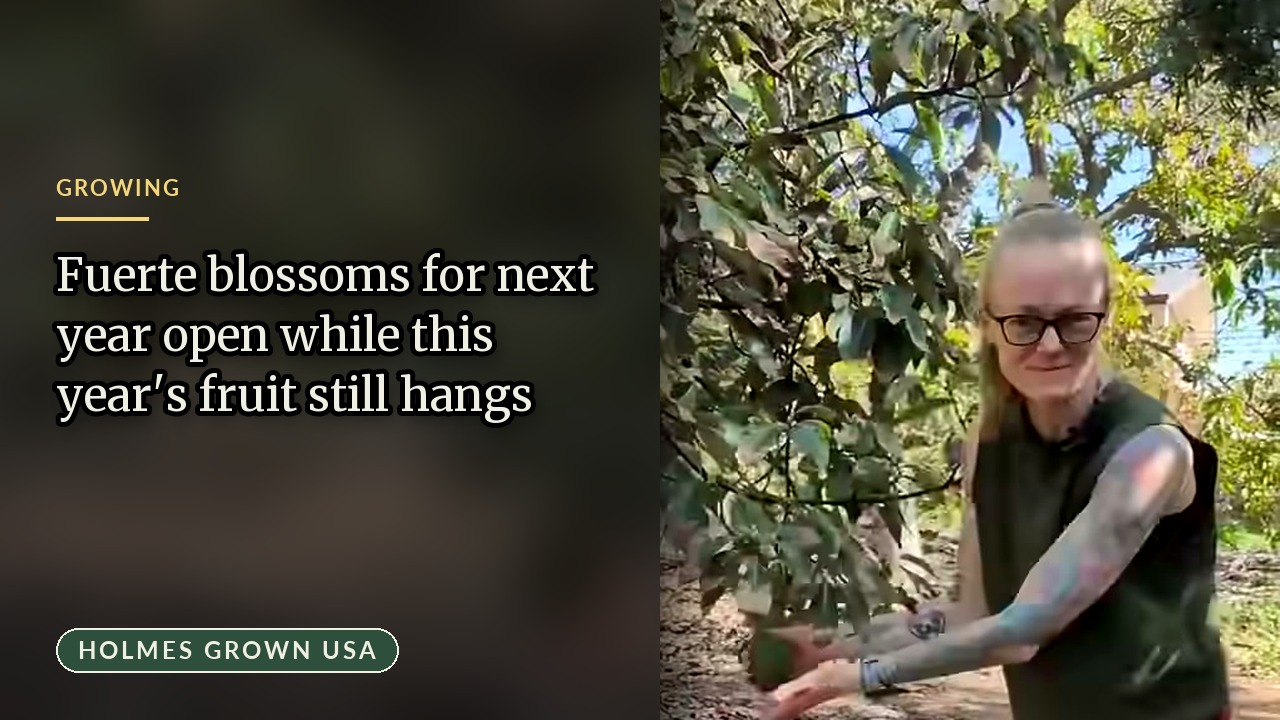
In this clip we are standing between two kinds of fruit: a cluster on a branch that did not put out any new leaves, already showing sun damage, and fruit on a nicely shaded part of the tree that will almost certainly be shipped.
What does a sunburned avocado look like?
Sunburn shows up on the exposed side of the fruit, and on a tree it is usually worst on the south and southwest sides. It starts as a pale yellowish patch; the center can then turn black, brown or red before the skin dies back or withers. Exposed twigs and bark can burn too, and badly sunburned limbs can develop cankers.
It is a surface problem on a fruit that may be perfectly good inside, but the blemish is enough to keep it out of the premium grade that packing houses and grocery stores want. Fruit that bad will not end up in the mail to you either.
Read nextAvocado Harvesting Gear: How to Use a Fruit-Picking Apron Without Bruising
Why some fruit ends up exposed
It comes down to the flush. A flush is a burst of new leaves, and a healthy avocado tree puts out new growth that shades the fruit it is carrying. The branch in the video did not flush, so there was nothing covering those avocados once the sun got on them.
Branches can go bare for many reasons: a tree under stress, heavy pruning that opened the canopy, pest damage, or simply a limb that is not growing. Water stress and salty water are common culprits in California — both cause tip-burn and leaf drop — and strong wind strips leaves too. The UC growers’ handbook, Avocado Production in California: A Cultural Handbook for Growers, Book Two, adds two more that matter on a grove: root rot, and heavy persea mite populations, which cause premature leaf drop that leaves bark and fruit open to sunburn. Persea mites also live on many weeds, which is one reason we keep weeds under control. Whatever the cause, fewer leaves mean more exposed fruit. We looked at how leaves signal a tree’s condition in avocado tree leaf health.
What good shade looks like
Compare that with the fruit on the other side of the tree: a nice flush of leaves overhead, and more shade coming from the neighboring avocado trees around it. Those are the avocados that will probably be shipped or sold at the grocery store.
That is one advantage of trees planted close enough to shade each other, and one reason growers are careful about how hard they open up a canopy. We covered the balance between letting light in and protecting fruit in avocado tree sunburn and pruning water sprouts.
Can you prevent it?
Mostly by keeping the tree healthy enough to hold a full canopy. That means consistent water, especially going into summer heat, because a stressed tree drops leaves and a thin canopy lets sun through. Sunburned fruit also tends to shrivel or drop early in a heat wave, which we wrote about in why avocados shrivel and sunburn.
For bark, the handbooks are specific. Book Two says to whitewash young trees routinely at planting, and Avocado Production in California: A Cultural Handbook for Growers, Book One, suggests a thermal trunk wrap from a farm-supply store, taken off after the first year. Older trees get their trunks and major limbs whitewashed when the canopy thins or after heavy pruning or stumping. White interior latex paint diluted 50 percent with water works, as does an old grove mix of 50 pounds of hydrated lime and 4 pounds of zinc sulfate per 100 gallons of water, and kaolin clay sprays can ease heat stress on the leaves. If a tree has already lost leaves, hold off watering until the root zone is nearly dry, because a tree with fewer leaves uses less water. For fruit, though, the best protection is still the one the tree provides on its own.
Which side of an avocado tree gets the most sunburn?
The south and southwest faces, according to the handbook, so when you walk a row looking for burned fruit or bark, those are the sides to check first. The handbook makes the same point in its advice on trees recovering from a freeze: if new growth has not come back before hot weather, only the trunk and big limbs that face south and southwest need to be painted. A gap in the canopy matters most when it faces that way.
Why paint a stump or a freshly pruned limb right away?
Because avocado wood burns fast once it loses its leaf cover. The handbook puts it plainly: avocado branches are highly susceptible to sunburn. After stumping, it says to paint or whitewash the stumps immediately, and limbs opened up by heavy pruning get white water-based or plastic paint, not mineral-based paint. Burned, stressed wood also invites the branch and twig borer, a beetle that goes after stressed or dying wood; whitewashing and getting rid of brush piles promptly are the handbook’s prevention, since sprays do not reach the larvae. We went through the whole stumping method, stump painting included, in how stumping saved our grove through the water cuts.
The avocados we send out come from the well-shaded parts of the tree. Our 4lb and 6lb Hass boxes are picked the week they ship, and when the trees are between harvests you can join the waitlist on either page.
This post is part of our guide to growing avocado trees.