When a Root Rot Tree Comes Out: Replanting on Tolerant Rootstock
What is root rot? It is a disease that affects many kinds of trees, avocados among them, and it is one of the most serious problems an avocado grower faces. The tree in this clip has it badly enough that it is coming out.
What goes in its place is the more hopeful part: a different variety, grafted onto a rootstock that is tolerant of root rot.
What the signs look like
On this tree, two things stand out:
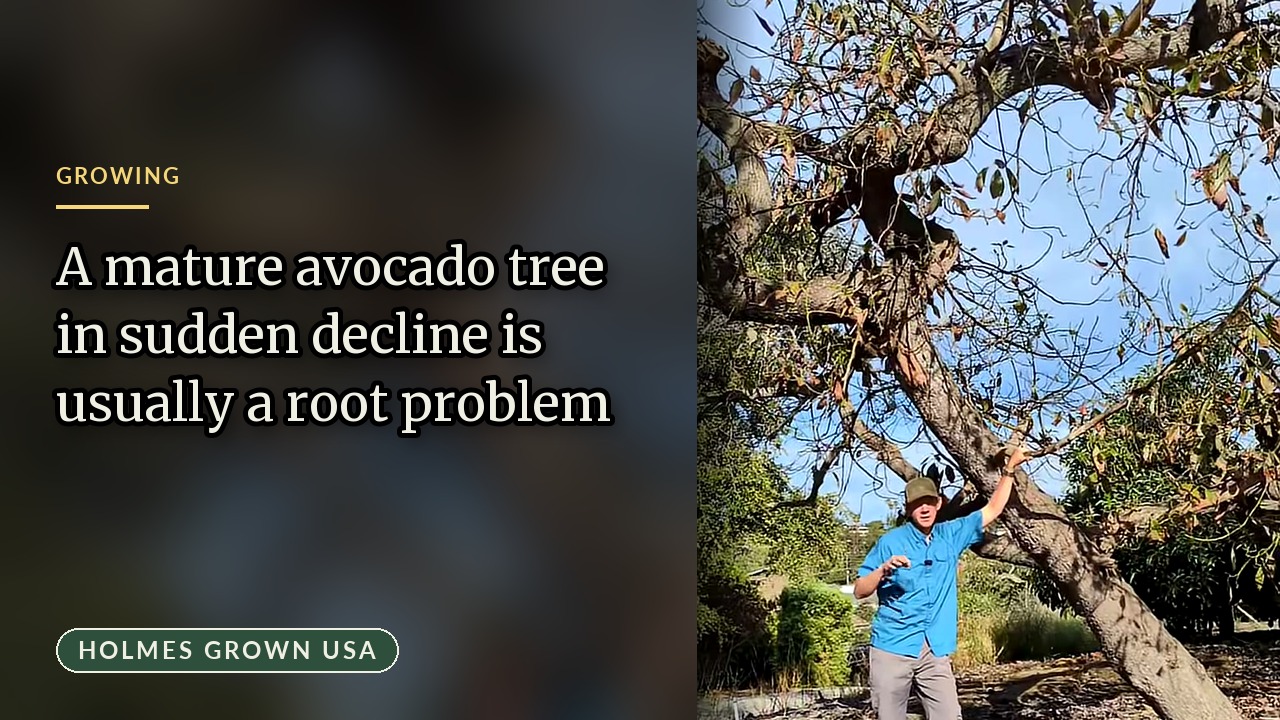
- A lot of broken branches. Dead and dying wood becomes brittle and snaps.
- Not much foliage through the canopy. You can see straight through the tree where there should be a dense layer of leaves.
Other things can produce a thin canopy, including drought stress, compacted soil and pests, so a sparse tree is a reason to investigate rather than a diagnosis on its own. We walked through one of those look-alikes in diagnosing root compaction and soil stress.
Read nextAvocado Tree Biology: How Roots, Pits, and Beneficial Insects Protect the Grove
Why root rot is so hard on avocados
Avocado root rot is caused by a soil-borne organism, Phytophthora cinnamomi, that attacks the fine feeder roots. Avocado feeder roots are shallow and delicate to begin with, and once they are damaged the tree cannot take up the water and nutrients it needs, however much you give it. The decline shows up above ground as small, pale leaves, wilting, leaf drop and dieback; below ground the feeder roots turn black and brittle, and a badly affected tree can wilt even when the soil beneath it is wet. The organism thrives in soil that stays wet and drains poorly: the UC handbook warns that as little as three days of saturated soil can set roots up for attack, and that adding more water to a wilting, root-rotted tree only makes things worse. Root rot has been the most important disease in California avocado growing since it was identified around 1940, and it still is.
A mildly affected tree can sometimes be nursed along. The handbook’s program combines careful irrigation, a thick layer of coarse mulch, gypsum and phosphonate (phosphite) treatments, with trunk injection the most effective method on badly diseased trees. None of it eradicates the organism; root rot needs managing for the life of the tree. A tree as far gone as this one is usually better replaced.
Taking it out
We have already capped this tree, and it will be removed. It is never easy to take out a tree, but a declining tree still takes up space and irrigation without giving much back. On an older grove like ours, some of that renewal is part of the long-term plan, which we described in revitalizing our 10-acre grove.
Why rootstock is the real fix
Commercial avocado trees are grafted: the fruiting variety on top, a separate rootstock below. That arrangement lets growers choose the roots for toughness. Rootstocks selected for tolerance to root rot are the most practical defense against the disease, because they keep growing in soil where a susceptible tree would fail. Some do it by regrowing roots quickly, others by slowing the infection down.
The word tolerant is deliberate. The University of California growers’ handbook is blunt that there is no true resistance to Phytophthora cinnamomi in rootstocks that can be grafted to avocado — only degrees of tolerance. Historically, most California trees were grafted onto seedling Topa Topa roots, which are very susceptible to root rot (on them, the handbook says, other controls only postpone the tree’s decline), and the clonal tolerant rootstocks developed since cost more but give a replant a far better start.
So the replacement will be a different variety on top, and underneath it, one of those root rot tolerant rootstocks. Tolerant is not the same as immune, which is why drainage and not overwatering still matter. The handbook also warns that replanting where a tree died of root rot is not as simple as just putting in a tolerant rootstock; its replant advice adds things like planting on a mound so the root ball sits above the native soil, a wood-based mulch a few inches deep kept off the trunk, and gypsum around the base. Book Two of the handbook adds that mounds increased survival and growth by as much as 1800% in the first three years on infested clay, and that fumigating the soil and replanting is not recommended, because the organism re-invades and the root rot gets worse than before. It also says a young tree interplanted among older ones needs its own irrigation line, since its watering timing and amounts are different. We explain how we think about water in how much water an avocado tree needs.
Got other avocado questions? Ask us, we are happy to answer them. And while the grove renews itself one tree at a time, the healthy trees keep producing for our 4lb and 6lb Hass boxes, which ship free in season with a waitlist on each page between harvests. Until the trees are picking again, the avocado scoop, the Hawaiian shirt and our hats ship year-round.
Try this: Look at the branch tips before you look at the roots. Broken, bare tips across a lot of the tree is the sign that sends us digging.
This post is part of our guide to growing avocado trees.