How to Tell If an Avocado Is Bad (and When It Only Looks Bad)
Somebody picks up an avocado with wrinkled, blotchy, nearly black skin, decides it is past saving, and drops it in the bin. It happens in kitchens all day long.
We grow these for a living, and the honest answer is that most of the avocados thrown out in American kitchens were perfectly good. The skin is a poor guide to what is happening inside. The one that looks like it has been through something is very often the one you want on toast.
Here is how to actually tell, starting with the test that settles it in about two seconds.
The stem test is the one that matters
At the top of the avocado there is a small dry stem cap. Flick it with your thumbnail and it will either come away or it will not, and what you find underneath is the whole answer.
- It pops off and the patch underneath is green: ripe. Eat it today or tomorrow.
- It pops off and the patch is brown: gone too far. This is the one that will be stringy inside.
- It will not budge: not ready yet. Nothing wrong with it, it simply has not started.
That is it. It takes a second, it costs you nothing, and it is far more reliable than looking at the outside of the fruit.
Wrinkled, dark skin is not rot
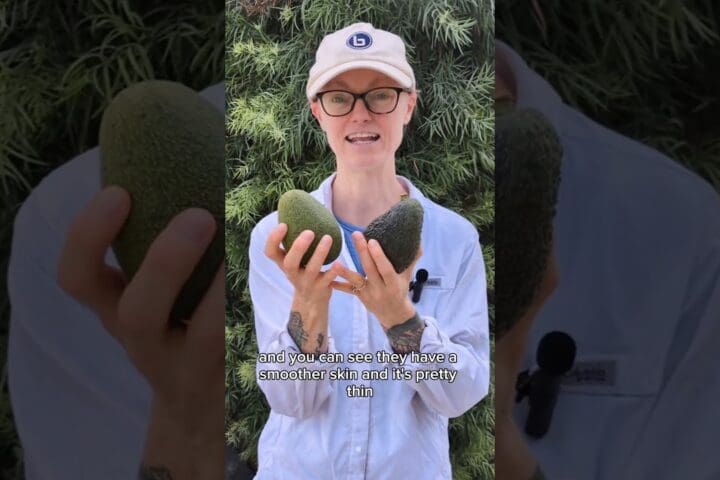
Hass skin darkens from green to deep purple-black as the fruit ripens, and it puckers a little as it goes. That is the fruit doing exactly what it is supposed to do. A slightly shrivelled, ugly-looking Hass that still gives gently under your whole palm is usually at its creamiest.
Judge with your hand rather than your eyes. Cradle the avocado in your palm and squeeze gently — never with a fingertip, which just bruises it. You are feeling for a slight give, like the flesh at the base of your thumb.
What genuinely spoiled actually looks like
There is a real difference between an avocado that is past its best and one that has gone off. Cut it open and you are looking for:
- Grey-brown flesh all the way through, often stringy or fibrous. Not a few dark fibres near the pit, which is normal and harmless — the whole flesh gone dull and mushy.
- A sour or rancid smell. A good avocado smells of almost nothing. If it smells sharp or fermented, trust that. Very late-season Hass is the most prone to this: the University of California grower handbook notes that late fruit often turns rancid quickly once it softens, so eat those promptly.
- Fuzzy mould, or liquid sitting in the cavity.
The rots behind most of this are fungi that get in while the fruit is on the tree or at picking, and only show once it softens. The University of California handbook describes three common ones. Stem end rot starts as slight shrivelling around the stem button and spreads from the narrow end as dark decay with a sharp edge, which is why a brown patch under the stem cap deserves a closer look. Anthracnose shows as black, sunken spots on the skin that rot down into the flesh, sometimes with pink spore masses on the surface. Dothiorella fruit rot can start anywhere on the skin, runs brown streaks lengthwise through the flesh and carries a greyish mould. The handbook calls postharvest rots a relatively minor problem in California.
Short of those, you probably have a perfectly good avocado and a scoop or two to trim off. Brown patches can be cut away exactly as you would with a bruise on an apple.
A hard avocado is not a bad avocado
This is the other half of the confusion, and it surprises people: an avocado does not ripen on the tree. It can hang on the branch for months without softening, and only starts to ripen once it is picked. Growers have known this for a long time: a Spanish account from 1526 already described avocados being gathered before they were ripe and stored until they ripened perfectly.
So a rock-hard avocado has not failed. Its clock has only just started. Leave it on the counter for a few days, or put it in a paper bag with a banana if you are in a hurry. We wrote more about that timeline in how long shipped avocados actually last.
How to stop losing them in the first place
The complaint we hear is rarely that avocados go bad. It is that they all go perfect on the same afternoon.
The fix takes four seconds a day. As each one reaches the point where it gives slightly under your palm, move that one to the fridge. Cold does not ripen an avocado, it pauses it, so you are holding it at its peak while the rest catch up on the counter. A batch that would have peaked in two days will feed you across two weeks instead.
Our full method — the palm test, the stem peek, the colour change — is in the avocado ripening guide.
Why ours behave differently
A grocery store avocado started its clock days or weeks before you saw it, in a packing house, and has been quietly softening through every step since. You are buying fruit somewhere in the middle of its life with no way of knowing how far along it is.
We pick to order, so the fruit leaves the tree the week it ships and arrives firm on purpose. The ripening happens on your counter, where you can watch it, which is the whole reason the timing is easier to manage.
Our 4lb and 6lb Hass boxes ship free, picked to order. If you are curious which variety you are actually holding, the guide to avocado varieties covers how Hass, Fuerte and the rest behave differently.
This is part of our complete guide to choosing, ripening and using avocados — when the season runs, how the varieties differ, how to ripen fruit at home and what to do with it.